MCQ
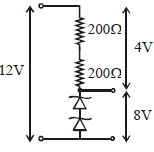
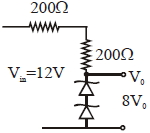
The circuit shown below is working as a $8\; \mathrm{V}\;dc$ regulated voltage source. When $12 \;\mathrm{V}$ is used as input, the power dissipated (in $\mathrm{mW}$ ) in each diode is

(considering both zener diodes are identical)
  • A
    $20$
  • B
    $8$
  • C
    $24$
  • $40$

Answer

Correct option: D.
$40$
d
Current in circuit $=\frac{4}{400}=\frac{1}{100} \mathrm{A}$

So power dissipited in each diode $=$ $\mathrm{VI}$

$=4 \times \frac{1}{100} \;\mathrm{W}$

$=40 \times 10^{-3}\; \mathrm{mW}$

Need a full question paper?

Generate a complete, print-ready paper with questions like this in minutes — across 16+ boards, with answer keys.

Start Generating Free

Similar questions

The magnifying power of a simple microscope can be increased, if we use eye-piece of
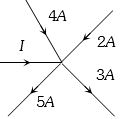
In the given current distribution what is the value of $I$ .............. $A$
The two vectors $\vec A = -2\widehat i + \widehat j + 3\widehat k$ and $\vec B = 7\widehat i + 5\widehat j + 3\widehat k$ are :-
While measuring the acceleration due to gravity by a simple pendulum, a student makes a positive error of $1\%$ in the length of the pendulum and a negative error of $3\%$ in the value of time period. His percentage error in the measurement of $g$ by the relation $g = 4{\pi ^2}\left( {l/{T^2}} \right)$ will be  ........ $\%$
A sample of an ideal gas undergoes an isothermal expansion. If $d Q, d U$ and $d W$ represent the amount of heat supplied, the change in internal energy and the work done respectively, then
The mass of a spaceship is $1000\ kg$. It is to be launched from the earth's surface out into free space. The value of $g$ and $R$( radius of earth) are $10\ m/s^2 $ and $6400\ km$ respectively. The required energy for this work will be
At $10^o C$ the value of the density of a fixed mass of an ideal gas divided by it pressure is $x.$ At  $110^o C$ this ratio is
A conductor in the form of a right angle $ABC$ with $AB = 3\, cm$ and $BC = 4\, cm$ carries a current of $10\, A$. There is a uniform magnetic field of $5\, T$ perpendicular to the plane of the conductor. The force on the conductor will be......$N$
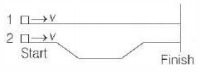
Two small blocks slide without losing contact with the surface along two frictionless tracks $1$ and $2$ , starting at the same time with same initial speed $v$. Track $1$ is perfectly horizontal, while track $2$ has a dip in the middle, as shown in the figure.Which block reaches the finish line first?[Hint: Use velocity-time graph to solve]
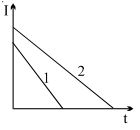
Two identical inductance carry currents that vary with time according to linear laws (as shown in figure). In which of two inductance is the self induction $emf$ greater?