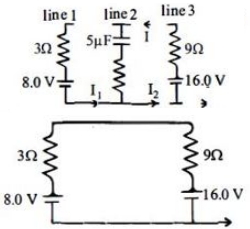
The circuit shown here has two batteries of $8.0\,V$ and $16.0\,V$ and three resistors $3\,\Omega ,\,9\,\Omega $ and $9\,\Omega $ and a capacitor of $5.0\,\mu F.$
How much is the current $I$ in the circuit in steady state? ................... $A$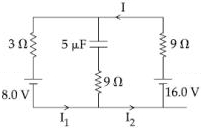
JEE MAIN 2014, Diffcult


Download our appand get started for free
Experience the future of education. Simply download our apps or reach out to us for more information. Let's shape the future of learning together!No signup needed.*
Similar Questions
- 1Two cities are $150\,\, km$ apart. Electric power is sent from one city to another city through copper wires. The fall of potential per $km$ is $8\,\, volt$ and the average resistance per km is $0.5 \,\,\Omega .$ The power loss in the wire isView Solution
- 2$12$ cells each having same $emf$ are connected in series with some cells wrongly connected. The arrangement is connected in series with an ammeter and two cells which are in series. Current is $3 \,A$ when cells and battery aid each other and is $2\, A$ when cells and battery oppose each other. The number of cells wrongly connected isView Solution
- 3View SolutionWhich of the following has a negative temperature coefficient
- 4The equivalent resistance between $x$ and $y$ in the circuit shown is ............. $\Omega$View Solution
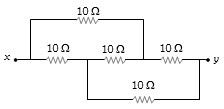
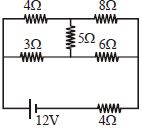
- 5In the circuit shown in the figure, no current flows through the ideal ammeter. If the internal resistance of the cell is negligible, the value of unknown resistance $R $ is .............. $\Omega$View Solution
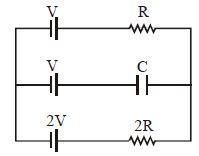
- 6View SolutionIn the given circuit, with steady current, the potential drop across the capacitor must be
- 7An ammeter $A$ of finite resistance, and a resistor $R$ are joined in series to an ideal cell $C$. $A$ potentiometer $P$ is joined in parallel to $R$. The ammeter reading is $I_0$ and the potentiometer reading is $V_0$. $P$ is now replaced by a voltmeter of finite resistance. The ammeter reading now is $I$ and the voltmeter reading is $V$.View Solution

- 8$STATEMENT-1$ In a Meter Bridge experiment, null point for an unknown resistance is measured. Now, the unknown resistance is put inside an enclosure maintained at a higher temperature. The null point can be obtained at the same point as before by decreasing the value of the standard resistance. andView Solution
$STATEMENT-2$ Resistance of a metal increases with increase in temperature.
- 9A metal wire of resistance $3\,\Omega $ is elongated to make a uniform wire of double its previous length. The new wire is now bent and the ends joined to make a circle. If two points on this circle make an angle $60^o$ at the centre, the equivalent resistance between these two points will beView Solution
- 10In the given figure the ratio of current in $8\,\Omega $ and $3\,\Omega $ will beView Solution