MCQ
The degree of the differential equation $\frac{\text{d}^3\text{y}}{\text{dx}^3}+3\frac{\text{d}^2\text{y}}{\text{dx}^2}=\text{x}^2\log\frac{\text{d}^3\text{y}}{\text{dx}^3}$ is:
  • A
    1
  • B
    2
  • C
    3
  • none of these

Answer

Correct option: D.
none of these
Degree of given differential equation is not defined.

Need a full question paper?

Generate a complete, print-ready paper with questions like this in minutes — across 16+ boards, with answer keys.
Start Generating Free

Similar questions

Let a unit vector $\hat{\mathrm{t}}=\mathrm{x} \hat{\mathrm{i}}+\mathrm{y} \hat{\mathrm{j}}+\mathrm{z} \hat{\mathrm{k}}$ make angles $\frac{\pi}{2}, \frac{\pi}{3}$ and $\frac{2 \pi}{3}$ with the vectors $\frac{1}{\sqrt{2}} \hat{\mathrm{i}}+\frac{1}{\sqrt{2}} \hat{\mathrm{k}}, \frac{1}{\sqrt{2}} \hat{\mathrm{j}}+\frac{1}{\sqrt{2}} \hat{\mathrm{k}}$ and $\quad \frac{1}{\sqrt{2}} \hat{\mathrm{i}}+\frac{1}{\sqrt{2}} \hat{\mathrm{j}} \quad$ respectively. If $\overrightarrow{\mathrm{v}}=\frac{1}{\sqrt{2}} \hat{\mathrm{i}}+\frac{1}{\sqrt{2}} \hat{\mathrm{j}}+\frac{1}{\sqrt{2}} \hat{\mathrm{k}}$, then $|\hat{\mathrm{u}}-\overrightarrow{\mathrm{v}}|^2$ is equal to
The number of arbitrary constants in the particular solution of differential equation of fourth order is:
$\int\frac{\text{dx}}{\sin(\text{x-a})\sin(\text{x-b})}$ is equal to:
If $\text{g(f(x))}=|\sin\text{x}|$ and $\text{f(g(x))}=(\sin\sqrt{\text{x}})^2,$ then
Let $f$ be differentiable at $x = 0$ and $f ‘ (0) = 1$. Then $\mathop {Lim}\limits_{h \to 0} \,\,\frac{{{\text{f}}(h) - {\text{f}}( - 2h)}}{h}$=
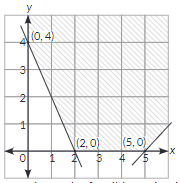
A linear programming problem (LPP) along with the graph of its constraints is shown below. The corresponding objective function is
Minimize: $Z=3 x+2 y$. The minimum value of the objective function is obtained at the corner point ( 2 , 0).
The optimal solution of the above linear programming problem $\qquad$
Image
Let $a$ , $b$ and $c$ are real numbers such that $a^2 + b^2 + c^2 = 1$ , then the maximum value of $(4b -3c)^2 + (4a -2c)^2 + (3a -2b)^2$ is
Let $\mathrm{f}$ be a non-negative function in $[0,1]$ and twice differentiable in $(0,1) .$ If $\int_{0}^{x} \sqrt{1-\left(f^{\prime}(t)\right)^{2}} \,d t=\int \limits_{0}^{x} f(t) \,d t$ $0 \leq x \leq 1$ and $f(0)=0$, then $\lim \limits _{x \rightarrow 0} \frac{1}{x^{2}} \int \limits_{0}^{x} f(t)\, d t:$
Find the direction cosines of the line that makes equal angles with the three axes in space.
Let $f (x) =$ $\left[ {\begin{array}{*{20}{c}}  {\tfrac{{1\,\, + \,\,\cos \,\,2\,\pi \,x}}{{1\,\, - \,\,\sin \,\,\pi \,x}}\,\,\,\,\,\,\,\,\,\,\,\,\,}&{,\,\,\,\,\,x\,\, < \,\,\tfrac{1}{2}} \\   {p\,\,\,\,\,\,\,\,\,\,\,\,\,\,\,\,\,\,\,\,\,\,\,\,\,\,\,\,\,\,\,\,\,\,\,\,\,\,\,\,}&{,\,\,\,\,\,x\,\, = \,\,\tfrac{1}{2}} \\   {\tfrac{{\sqrt {2\,x\,\, - \,\,1} }}{{\sqrt {4\,\, + \,\,\sqrt {2\,x\,\, - \,\,1} } \,\,\, - \,\,\,2}}}&{,\,\,\,\,\,x\,\, > \,\,\tfrac{1}{2}} \end{array}} \right.$ . If $f (x)$ is discontinuous at $x =\frac{1}{2}$ , then