The density of ice is $0.9 \,g / cm ^3$. What percentage by volume of the block of ice floats outside the water is ..........$\%$
Medium
Download our app for free and get started
The forces acting on the ice must balance each other.
Hence buoyant force acting upwards = Weight of the ice
$\Longrightarrow V_{i m m} \rho g=V d g$
$\Longrightarrow \frac{V_{i m m}}{V}=\frac{d}{\rho}=0.9$
Hence, fraction of ice outside water $=1-0.9=0.1$
$=0.1\times 100\%=10\%$

Download our appand get started for free
Experience the future of education. Simply download our apps or reach out to us for more information. Let's shape the future of learning together!No signup needed.*
Similar Questions
- 1View SolutionA cube of ice has a iron piece fronzen unside at. The cube floats un a beakerfilled with water, when the ice melts then, the level of water in beaker.
- 2The velocity of upper layer of water in a river is $36 kmh ^{-1}$. Shearing stress between horizontal layers of water is $10^{-3} Nm ^{-2}$. Depth of the river is $m$. (Co-efficiency of viscosity of water is $10^{-2} \,Pa . s$ )View Solution
- 3Two water pipes of diameters $ 2 cm $ and $4 cm $ are connected with the main supply line. The velocity of flow of water in the pipe of $ 2 cm$ diameter isView Solution
- 4By sucking through a straw, a student can reduce the pressure in his lungs to $750\, mm\, of\, Hg$ (density $= 13.6\, gm/cm^3$). Using the straw, he can drink water from a glass upto a maximum depth of ....... $cm$View Solution
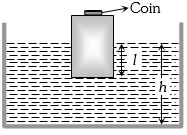
- 5A wooden block, with a coin placed on its top, floats in water as shown in fig. the distance $l $ and $h$ are shown there. After some time the coin falls into the water. ThenView Solution
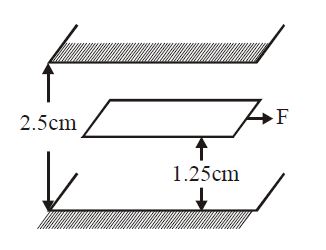
- 6A space $2.5\ cm$ wide between two large plane surfaces is filled with oil. Force required to drag very thin plate of area $0.5\ m^2$ just midway the surfaces at a speed of $0.5\ m/sec$ is $1\ N$ The coefficient of viscosity in $kg-s/m^2$ is :View Solution
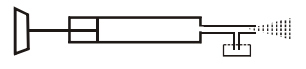
- 7A spray gun is shown in the figure where a piston pushes air out of a nozzle. A thin tube of uniform cross section is connected to the nozzle. The other end of the tube is in a small liquid container. As the piston pushes air through the nozzle, the liquid from the container rises into the nozzle and is sprayed out. For the spray gun shown, the radii of the piston and the nozzle are $20 \ mm$ and $1 \ mm$ respectively. The upper end of the container is open to the atmosphere. $Image$View Solution
$1.$ If the piston is pushed at a speed of $5 \ mms ^{-1}$, the air comes out of the nozzle with a speed of
$(A)$ $0.1 \ ms ^{-1}$ $(B)$ $1 \ ms ^{-1}$ $(C)$ $2 \ ms ^{-1}$ $(D)$ $8 \ ms ^{-1}$
$2.$ If the density of air is $\rho_{ a }$ and that of the liquid $\rho_{\ell}$, then for a given piston speed the rate (volume per unit time) at which the liquid is sprayed will be proportional to
$(A)$ $\sqrt{\frac{\rho_{ a }}{\rho_{\ell}}}$ $(B)$ $\sqrt{\rho_a \rho_{\ell}}$ $(C)$ $\sqrt{\frac{\rho_{\ell}}{\rho_{ a }}}$ $(D)$ $\rho_{\ell}$
Give the answer question $1$ and $2.$
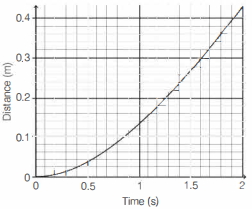
- 8A steel ball is dropped in a viscous liquid. The distance of the steel ball from the top of the liquid is shown below. The terminal velocity of the ball is closest to .......... $m/s$View Solution
- 9A very large block of ice of the size of a volleyball court and of uniform thickness of $8 \,m$ is floating on water. A person standing near its edge wishes to fetch a bucketful of water using a rope. The smallest length of rope required for this is about ............... $m$View Solution
- 10A cylinder containing water, stands on a table of height $H$. A small hole is punched in the side of cylinder at its base. The stream of water strikes the ground at a horizontal distance $R$ from the table. Then the depth of water in the cylinder is ............View Solution