MCQ
The dependence of drift velocity on applied electric field E is:
- A$v_d$ will remain constant
- ✓$v_d \propto E$
- C$v_d \propto \frac{1}{ E }$
- Dnone of the above
Generate a complete, print-ready paper with questions like this in minutes — across 16+ boards, with answer keys.
A battery is connected between two points A and B on the circumference of a uniform conducting ring of radius r and resistance R. One of the arcs AB of the ring subtends an angle θ at the centre. The value of the magnetic induction at the centre due to the current in the ring is
|
(a) Proportional to 2(180° - θ) |
(b) Inversely proportional to r |
|
(c) Zero, only if θ = 180° |
(d) Zero for all values of θ |
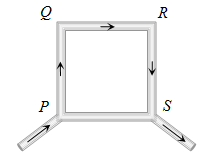
PQRS is a square loop made of uniform conducting wire the current enters the loop at P and leaves at S. Then the magnetic field will be
|
(a) Maximum at the centre of the loop |
(b) Zero at the centre of loop |
|
(c) Zero at all points inside the loop |
(d) Zero at all points outside of the loop |
A long straight wire carries a current of π amp. The magnetic field due to it will be 5  at what distance from the wire [
 permeability of air]
|
(a) |
(b) |
(c) |
(d) |
The phase difference between input and output voltages of a CE circuit is
|
(a) 0o |
(b) 90o |
(c) 180o |
(d) 270o |
The magnetic field near a current carrying conductor is given by
|
(a) Coulomb’s law |
(b) Lenz’ law |
(c) Biot-savart’s law |
(d) Kirchoff’s law |
In the following reaction  is
is
|
(a) 28 |
(b) 27 |
(c) 26 |
(d) 22 |
The radius of curvature of the curved surface of a plano-convex lens is 20cm. If the refractive index of the material of the lens be 1.5, it will.
If E is the electric field intensity of an electrostatic field, then the electrostatic energy density is proportional to
|
(a) E |
(b) |
(c) |
(d) |


