Question
The diagram given alongside represents a stage in cell division.
Study the same and answer the questions that follow:
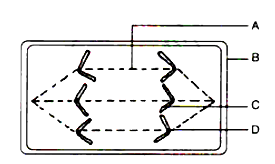
(i) Identify the stage of cell division.
(ii) Name the parts labeled A,B,C and D.
(iii) What is the unique feature observed in this stage?
(iv) Where does this type of cell division usually occur?
(v) How many daughter cells are formed from this type of cell division?
(vi) Is the dividing cell shown a plant or an animal cell?
Give a reason to support your answer.
Answer

(i) Anaphase in a plant cell
(ii) A - Spindle fibre
B - Cell wall
(iii) The homologous daughter chromatids or chromosomes begin to move towards opposite poles.
(iv) This type of cell division occurs usually in the somatic cells.
(v) Two daughter cells are formed from this type of cell division.
(vi) The dividing cell shown is a plant cell because of the presence of cell wall and the absence of centriole.

Need a full question paper?

Generate a complete, print-ready paper with questions like this in minutes — across 16+ boards, with answer keys.

Start Generating Free

Similar questions

Draw a diagram of the human eye as seen in a vertical section and label the part which suits the following functions/descriptions :
(i) The layer which prevents reflection of light
(ii) The structure that helps to focus light on retina
(iii) The region of distinct vision
(iv) The part which transmits the impulse to the brain
(v) The outermost transparent layer in front of the eye lens
(vi) The fluid present in the anterior part of the eye in from of the eye lens
Why is pollution prevention important?
The diagram given below represents the spinal cord of a mammal, seen in a transverse section together with the nerves. Study the diagram and then answer the questions given below:

(i) Label the parts 1—8 indicated by guidelines.
(ii) What do the arrows indicate? What is the pathway indicated termed?
(iii) What type of nerve is shown in the diagram?
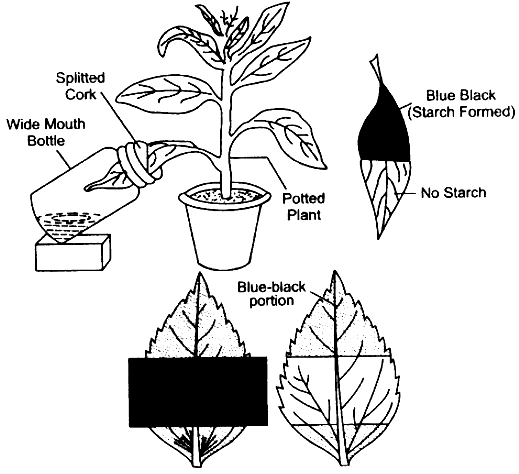
The figure given below is for performing an experiment on photosynthesis.

Answer the following:
(i) What is the aim of this experiment?
(ii) Describe an experiment to show that light is necessary for photosynthesis.
(iii) What do you conclude from this experiment?
(iv) What is the role of light in photosynthesis?
Mention four disadvantages of transpiration to the plant.
Most leaves have the upper surface more green and shiny than the lower one. Why?
Write short note on the following:
Guttation
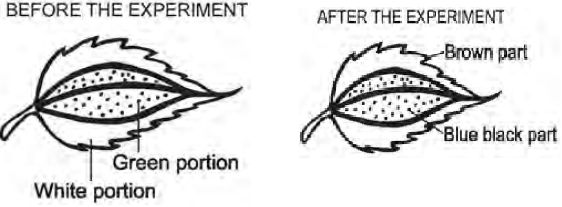
The diagrams given below is an experiment conducted to study a factor necessary for photosynthesis. Observe the diagrams and then answer the following questions :

Image
(i) What is the aim of the experiment?
(ii) Identify the special condition inside the flask.
(iii) In what manner do the leaves 1 and 2 differ at the end of the starch test?
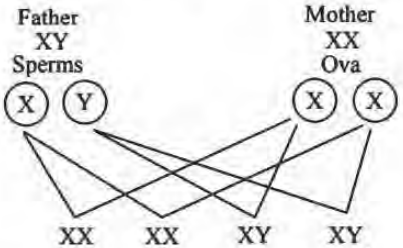
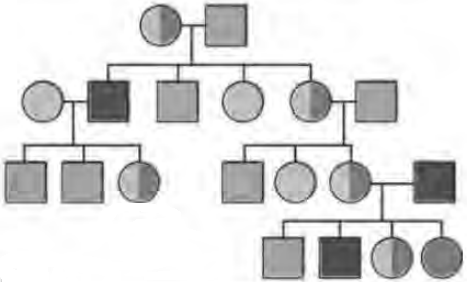
Given below are some pictures. Match them with the correct options.

PicturesCross
1.Imagea.Incomplete 
2.Imageb.Sex determination
3.Imagec.Dihybrid cross
4.Imaged.Pedigree analysis