Question
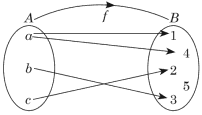
The diagram given below shows that
Image

Answer

(d) : As $f(a)$ is not unique, thus $f$ is not a function.

Need a full question paper?

Generate a complete, print-ready paper with questions like this in minutes — across 16+ boards, with answer keys.

Start Generating Free

Similar questions

Choose the correct answer from the given four options.
Two dice are thrown. If it is known that the sum of numbers on the dice was less than $6,$ the probability of getting a sum $3,$ is:
The domain of $\sin ^{-1} x+\cos ^{-1} x+\tan ^{-1} x$ is
If $\cot^{-1}(\sqrt{\cos\alpha})-\tan^{-1}(\sqrt{\cos\alpha})=\text{x},$ then $\sin\text{x}$ is equal to:
  1. $\tan^2\Big(\frac{\alpha}{2}\Big)$
  2. $\cot^2\Big(\frac{\alpha}{2}\Big)$
  3. $\tan\alpha$
  4. $\cot\Big(\frac{\alpha}{2}\Big)$
The number of points in $(-\infty,\infty)$ for which $\text{x}^{2}-\text{x}\sin\text{x}-\cos\text{x}=0,$ is:
In linear programming, lack of points for a solution set is said to:
Find the value of $ {\sin ^{ - 1}}\left( 1 \right):$
  1. $ \dfrac{\pi}{7}$
  2. $ \dfrac{\pi}{6}$
  3. $ \dfrac{\pi}{4}$
  4. $ \dfrac{\pi}{2}$
Directions: In the following questions, the Assertions (A) and Reason(s) (R) have been put forward. Read both the statements carefully and choose the correct alternative from the following:
Assertion (A): Assertion (A):For an objective function Z= 15x + 20y, corner points are (0, 0), (10, 0), (0, 15) and (5, 5). Then optimal values are 300 and 0 respectively.
Reason (R): The maximum or minimum value of an objective function is known as optimal value of LPP. These values are obtained at corner points.
  1. Both A and R are true and R is the correct explanation of A
  2. Both A and R are true but R is NOT the correct explanation of A
  3. A is true but R is false.
  4. A is false but R is true.
$\int_0^{2 \pi} \operatorname{cosec}^7 x d x=$
$\int\frac{\text{x}}{4+\text{x}^4}\text{ dx}$ is equal to:
  1. $\frac{1}{4}\tan^{-1}\text{x}^2+\text{C}$
  2. $\frac{1}{4}\tan^{-1}\Big(\frac{\text{x}^2}{2}\Big)$
  3. $\frac{1}{2}\tan^{-1}\Big(\frac{\text{x}^2}{2}\Big)$
  4. none of these.
The solution set of the inequation 2x + y > 5 is:
  1. half plane that contains the origin
  2. open half plane not containing the origin
  3. whole xy-plane except the points lying on the line 2x + y = 5
  4. none of these