MCQ
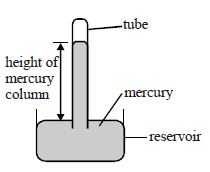
The diagram shows a simple mercury barometer.Which of the following does not cause the height of the mercury column to vary ?
  • A
    Changes in the atmospheric pressure
  • B
    Changes in the value of $g$
  • Evaporation of mercury from the barometer reservoir
  • D
    Leakage of air into the tube

Answer

Correct option: C.
Evaporation of mercury from the barometer reservoir
c
Atmospheric pressure is directly proportion to the height of mercury.

pressure due Weight of mercury in column is equal to atmospheric pressure, if g will vary, height should adjust so as to keep $W$ same.

 Leakage of air inside the tube will disturb the vacuum, due to which pressure inside the tube will become equal to atmospheric pressure and height of mercury will become $0.$

Evaporation of mercury does not cause the height to vary, because it doesn't not change the pressure at surface of reservoir.

Need a full question paper?

Generate a complete, print-ready paper with questions like this in minutes — across 16+ boards, with answer keys.

Start Generating Free

Similar questions

Escape velocity on earth is $11.2\, km/s$. What would be the escape velocity on a planet whose mass is $1000$ times and radius is $10$ times that of earth ......... $km/sec$​
The phase difference between the two particles situated on both the sides of a node is ... $^o$
A stunt man jumps his car over a crater as shown (neglect air resistance)
A steel rod of diameter $1\,cm$ is clamped firmly at each end when its temperature is $25\,^oC$ so that it cannot contract on cooling. The tension in the rod at $0\,^oC$ is approximately ......... $N$ $(\alpha = 10^{-5}/\,^oC,\,\,Y = 2 \times 10^{11}\,N/m^2)$
A particle is moving in $x y$-plane in a circular path with centre at origin. If at an instant the position of particle is given by $\frac{1}{\sqrt{2}}(\hat{i}+\hat{j})$, then velocity of particle is along .......
A ball is moving towards the wall as shown in diagram then its momentum is conserved
A block of mass $M$ is suspended from a wire of length $L$, area of cross-section $A$ and Young's modulus $Y$. The elastic potential energy stored in the wire is
The atmosphere on a planet is possible only if [where $v_{ rms }$ is root mean square speed of gas molecules on planet and $v_e$ is escape speed on its surface]
Law of equipartition of energy is used to:
A small asteroid is orbiting around the sun in a circular orbit of radius $r_0$ with speed $v_0$. A rocket is launched from the asteroid with speed $v=\alpha v_0$, where $v$ is the speed relative to the sun. The highest value of $\alpha$ for which the rocket will remain bound to the solar system is (ignoring gravity due to the asteroid and eff ects of other planets)