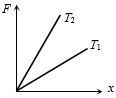
The diagram shows the change $x$ in the length of a thin uniform wire caused by the application of stress $F$ at two different temperatures $T_1$ and $T_2$. The variations shown suggest that
Easy


Download our appand get started for free
Experience the future of education. Simply download our apps or reach out to us for more information. Let's shape the future of learning together!No signup needed.*
Similar Questions
- 1The length of a rod is $20\, cm$ and area of cross-section $2\,c{m^2}$. The Young's modulus of the material of wire is $1.4 \times {10^{11}}\,N/{m^2}$. If the rod is compressed by $5\, kg-wt$ along its length, then increase in the energy of the rod in joules will beView Solution
- 2The normal density of a material is $\rho$ and its bulk modulus of elasticity is $K$. The magnitude of increase in density of material, when a pressure $P$ is applied uniformly on all sides, will beView Solution
- 3A steel rod of length $1\,m$ and cross sectional area $10^{-4}\,m ^2$ is heated from $0^{\circ}\,C$ to $200^{\circ}\,C$ without being allowed to extend or bend. The compressive tension produced in the rod is $........\times 10^4\,N$ (Given Young's modulus of steel $=2 \times 10^{11}\,Nm ^{-2}$, coefficient of linear expansion $=10^{-5}\, K ^{-1}$.View Solution
- 4The area of cross section of a steel wire $(Y = 2.0 \times {10^{11}}N/{m^2})$ is $0.1\;c{m^2}$. The force required to double its length will beView Solution
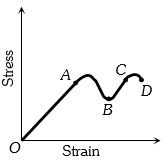
- 5In the below graph, point $B$ indicatesView Solution
- 6A compressive force, $F$ is applied at the two ends of a long thin steel rod. It is heated, simultaneously, such that its temperature increases by $\Delta T$. The net change in its length is zero. Let $l$ be the length of the rod, $A$ its area of cross- section, $Y$ its Young's modulus, and $\alpha $ its coefficient of linear expansion. Then, $F$ is equal toView Solution
- 7The density and breaking stress of a wire are $6 \times$ $10^4 \mathrm{~kg} / \mathrm{m}^3$ and $1.2 \times 10^8 \mathrm{~N} / \mathrm{m}^2$ respectively. The wire is suspended from a rigid support on a planet where acceleration due to gravity is $\frac{1^{\text {rd }}}{3}$ of the value on the surface of earth. The maximum length of the wire with breaking is ............ $\mathrm{m}$ (take, $\mathrm{g}=$ $\left.10 \mathrm{~m} / \mathrm{s}^2\right)$View Solution
- 8The elastic limit of brass is $3.5 \times 10^{10}\,N / m ^2$. Find the maximum load that can be applied to a brass wire of $0.75\,mm$ diameter without exceeding the elastic limit$.......\times 10^4\,N$View Solution
- 9A wire fixed at the upper end stretches by length $l$ by applying a force $F$. The work done in stretching isView Solution
- 10The Young's modulus of a wire of length $L$ and radius $r$ is $Y$ $N/m^2$. If the length and radius are reduced to $L/2$ and $r/2,$ then its Young's modulus will beView Solution