Question
The diameter of an air bubble which was initially $2\,mm$, rises steadily through a solution of density $1750\,kg\,m\,m ^{-3}$ at the rate of $0.35\,cms ^{-1}$. The coefficient of viscosity of the solution is poise (in nearest integer). (the density of air is negligible).
Answer

b
As the bubble is rising steadily the net force acting on it will be zero

(Because of density of air the value of mg can be neglected)

So $B = F \Rightarrow \frac{4 \pi}{3} R ^{3} \rho g =6 \pi \eta Rv$

Putting $R =1\,mm =10^{-3}\,m$

$\rho=1.75 \times 10^{3}\,kg / m ^{3}$

$g =10\,m / s ^{2}$

$v =0.35 \times 10^{-2}\,m / s$

$\eta=\frac{10}{9}=1.11$ SI unit $=11$ poise $( CGS )$

Need a full question paper?

Generate a complete, print-ready paper with questions like this in minutes — across 16+ boards, with answer keys.

Start Generating Free

Similar questions

Figure below shows a liquid being pushed out of the tube by a piston having area of cross section $2.0\,cm ^2$. The area of cross section at the outlet is $10\,mm ^2$. If the piston is pushed at a speed of $4\,cm s ^{-1}$, the speed of outgoing fluidis $.........\,cm s ^{-1}$.
A block of mass $1\,kg$ lies on a horizontal surface in a truck. The coefficient of static friction between the block and the surface is $0.6$ . If the acceleration of the truck is $5\,m\,s^{-2}$ . The frictional force acting on the block is ........ $N$ 
A particle performs simple harmonic motion with amplitude A. Its speed is increased to three times at an instant when its displacement is $\frac{2 \mathrm{~A}}{3}$. The new amplitude of motion is $\frac{\mathrm{nA}}{3}$. The value of $\mathrm{n}$ is____.
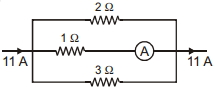
The ammeter reading in the circuit below is .............. $A$
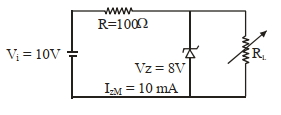
A Zener of breakdown voltage $V_{z}=8\,V$ and maximum zener current, $I _{ ZM }=10\,mA$ is subjected to an input voltage $V _{ i }=10\,V$ with series resistance $R=100\,\Omega$. In the given circuit $R_{L}$ represents the variable load resistance. The ratio of maximum and minimum value of $R_{L}$ is
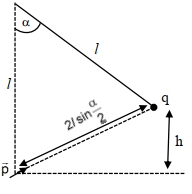
A point charge $q$ of mass $m$ is suspended vertically by a string of length $l$. A point dipole of dipole moment $\overrightarrow{ p }$ is now brought towards $q$ from infinity so that the charge moves away. The final equilibrium position of the system including the direction of the dipole, the angles and distances is shown in the figure below. If the work done in bringing the dipole to this position is $N \times( mgh )$, where $g$ is the acceleration due to gravity, then the value of $N$ is. . . . . . (Note that for three coplanar forces keeping a point mass in equilibrium, $\frac{F}{\sin \theta}$ is the same for all forces, where $F$ is any one of the forces and $\theta$ is the angle between the other two forces)
If the acceleration due to gravity is $10\,m{s^{ - 2}}$ and the units of length and time are changed in kilometer and hour respectively, the numerical value of the acceleration is
The $r.m.s.$ speed of a certain gas is v at $400\,K.$ The temperature at which the $r.m.s.$ speed becomes two times, will be ...... $K$
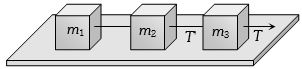
Three blocks of masses ${m_1},\,{m_2}$ and ${m_3}$ are connected by massless strings as shown on a frictionless table. They are pulled with a force ${T_3} = 40\,N$. If ${m_1} = 10\,kg,\,{m_2} = 6\,kg$ and ${m_3} = 4\,kg$, the tension ${T_2}$ will be ........ $N$