MCQ
The difference between $\Delta H$ and $\Delta U$ $(\Delta H - \Delta U),$ when the combustion of one mole of heptane $(I)$ is carried out a temperature $T$ is equal to
  • $-4\,RT$
  • B
    $-3\,RT$
  • C
    $3\,RT$
  • D
    $4\,RT$

Answer

Correct option: A.
$-4\,RT$
a
${C_7}{H_{16}}(l) + 11{O_2}(g) \to 7C{O_2}(g) + 8{H_2}O(l)$

$\Delta {n_g} = {n_p} - {n_r}$

$ = 7 - 11 =  - 4$

$\because \,\Delta H = \Delta U + \Delta {n_g}RT$

$\therefore \,\Delta H - \Delta U =  - 4\,RT$

Need a full question paper?

Generate a complete, print-ready paper with questions like this in minutes — across 16+ boards, with answer keys.
Start Generating Free

Similar questions

To obtain a buffer which should be suitable for maintaining a $pH$ of about $4 - 5,$ we need to have in solution, a mixture of
Which will have maximum $pH$
The $X-X$ bond length is $1.00{\text{ }}\mathop {\text{A}}\limits^o $ and $C-C$ bond length is $1.54{\text{ }}\mathop {\text{A}}\limits^o $. If $EN$ of $'X'$ and $'C'$ are $3.0$ and $2.0$ respectively. The $C-X$ bond length is likely to be ............ $\mathop {\rm{A}}\limits^{\rm{o}} $
Image
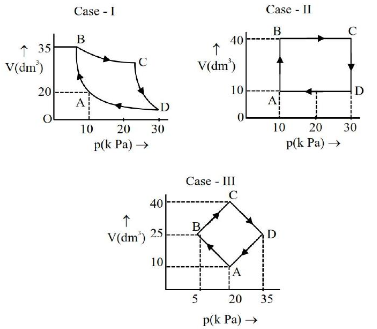
An ideal gas undergoes a cyclic transformation starting from the point A and coming back to the same point by tracing the path $\mathrm{A} \rightarrow \mathrm{B} \rightarrow \mathrm{C} \rightarrow \mathrm{D} \rightarrow \mathrm{A}$ as shown in the three cases above.
Choose the correct option regarding $\Delta \mathrm{U}$.
The end product B in the sequence of reactions

$R - X\xrightarrow{{KCN}}A\mathop {\xrightarrow{{NaOH}}}\limits_{{H_2}O} $  $B$  is

A hydrocarbon ' $X$ ' with formula $C _6 H _8$ uses two moles of $H _2$ on catalytic hydrogenation of its one mole. On ozonolysis, ' $X$ ' yields two moles of methane dicarbaldehyde. The hydrocarbon ' $X$ ' is :
Given below are two statements: one is labelled as Assertion $A$ and the other is labelled as Reason $R$.

Assertion $A:$ A mixture contains benzoic acid and napthalene. The pure benzoic acid can be separated out by the use of benzene.

Reason $R:$ Benzoic acid is soluble in hot water.

In the light of the above statements, choose the most appropriate answer from the options given below.

$Fe(OH)_2$ is precipitated from $Fe(II)$ solutions as a while solid but turns dark green and then brown due to the formation of
An electrochemical cell is set up as follows $Pt({H_2},\,1\,atm)/0.1\,M\,HCl$ $||\,\, 0.1 \,M$ acetic acid $/( {H_2},\,1\,atm)$ Pt $E.M.F.$ of this cell will not be zero because
The highest oxidation state of $Cr$ will be