Question
The difference between the outer and inner curved surface areas of a hollow right circular cylinder $14\ cm$ long is $88\ cm^2$​​​​​​​. If the volume of metal used in making the cylinder is $176\ cm^3​​​​​​​$​​​​​​​, find the outer and inner diameters of the cylinder. $\Big(\text{use}\ \pi=\frac{22}{7}\Big)$
Answer

The height of the hollow cylinder is $14\ cm$.
Let the inner and outer radii of the hollow cylinder are r cm and R cm respectively.
The difference between the outer and inner surface area of the hollow cylinder is
$=2\pi\text{R}\times14-2\pi\text{r}\times14$
$=28\pi(\text{R}-\text{r})\text{cm}^2$ By the given condition, this difference is $88$ square cm.
Hence, we have $=28\pi\Big(\text{R}-\text{r}\Big)=88$
$\Rightarrow\text{R}-\text{r}=\frac{44\times7}{14\times22}$
$\Rightarrow\text{R}-\text{r}=1$ The volume of the metal used in making the cylinder is
 $\text{V}_1=\pi\{(\text{R})^2-(\text{r})^2\}\times14\text{cm}^3$ By the given condition, the volume of the metal is $176$ cubic cm.
Hence, we have $\pi\{(\text{R})^2-(\text{r}^2)\}\times14=176$
$\Rightarrow\text{R}^2-\text{r}^2=\frac{176\times7}{14\times22}$
$\Rightarrow\text{R}^2-\text{r}^2=4$
$\Rightarrow(\text{R}-\text{r})(\text{R}+\text{r})=4$
$\Rightarrow1\times(\text{R}+\text{r})= 4$
$\Rightarrow\text{R}+\text{r}=4$
Hence, we have two equations with unknowns $R$ and $r R - r = 1 R + r = 4$ Adding the two equations,
we have $(R - r) + (R + r) = 1 + 4 \Rightarrow 2R = 5 \Rightarrow R = 2.5$
Then from the second equation, we have $r = 4 - 2.5 = 1.5$
 Therefore, the outer and inner diameters of the hollow cylinder are 5cm and $3\ cm$ respectively.

Need a full question paper?

Generate a complete, print-ready paper with questions like this in minutes — across 16+ boards, with answer keys.

Start Generating Free

Similar questions

Solve the following equations by using the method of completing the square:
$x^2 + 8x - 2 = 0$
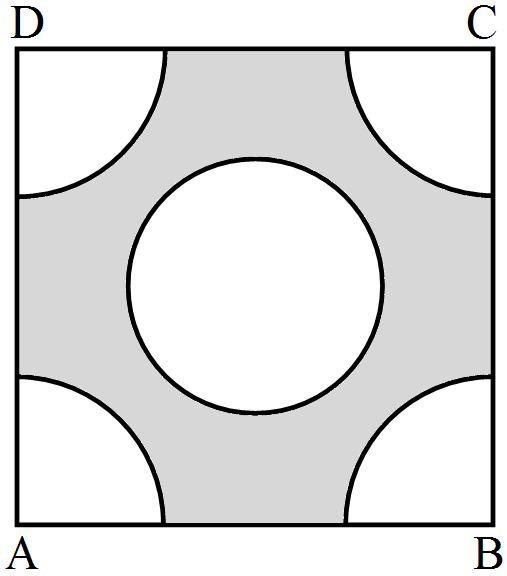
In the given figure, ABCD is a square of side $4\ cm.$ A quadrant of a circle of radius $1\ cm$ is drawn at each vertex of the square and a circle of diameter $2\ cm$ is also drawn. Find the area of the shaded region.
In an A.P. the first term is – 5 and last term is 45. If sum of all numbers in the A.P. is 120, then how many terms are there? What is the common difference?
Find the missing frequency (p) for the following distribution whose mean is 7.68.
x 3 5 7 9 11 13
f 6 8 15 P 8 4
Verify that the numbers given along side of the cubic polynomials below are their zeros. Also, verify the relationship between the zeros and coefficients in each case:
$\text{f}(\text{x})=2\text{x}^2+\text{x}^2-5\text{x}+2;\frac{1}{2},1,-2$
Compute the median from the following data:
Marks
0-7
7-14
14-21
21-28
28-35
35-42
42-49
Number of students
3
4
7
11
0
16
9
Find the distance between of the following points from the origin:
A(5, -12)
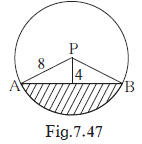
In the figure 7.47, seg AB is a chord of a circle with centre P. If PA = 8 cm and distance of chord AB from the centre P is 4 cm, find the area of the shaded portion.
Find the mean of the following data, using direct method:
Class
$0-10$
$10-20$
$20-30$
$30-40$
$40-50$
$50-60$
Frequency
$7$
$5$
$6$
$12$
$8$
$2$
Two squares have sides $x\ cm$ and $(x + 4)\ cm$. The sum of their areas is $656\ cm^2$​​​​​​​. Find the sides of the squares.