Question
The difference between two numbers is 15. Taking the smaller number as x; find:

(i) the expression for the larger number.

(ii) the larger number, if the sum of these numbers is 71.

Answer

Difference of two numbers = 15
Let smaller number = x
∴ Second number = x + 15
∴ Larger number = x + 15
If sum of two numbers = 71
Then x + x + 15 = 7
(i) 2x + 15 = 71
⇒ 2x = 71 - 15 = 56
$x=\frac{56}{2}=28$
(ii) Larger number = x + 15 = 28 + 15 = 43

Need a full question paper?

Generate a complete, print-ready paper with questions like this in minutes — across 16+ boards, with answer keys.
Start Generating Free

Similar questions

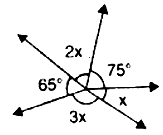
Find the value of $'x\ ’$ for the following figure:
Solve: 3(2x + 1) -2(x - 5) -5(5 - 2x) = 16
In a club has 360 members, 40 play carrom, 96 play table tennis, 144 play badminton, and remaining members play volley-ball. If no member plays two or more games, find the ratio of members who play:
(i) carrom to the number of those who play badminton.
(ii) badminton to the number of those who play table-tennis.
(iii) table-tennis to the number of those who play volley-ball.
(iv) volleyball to the number of those who play other games.
A man earns ₹ 25440 per month. He spends $\frac{1}{4}$ of it on house rent, $\frac{3}{8}$ on food and clothes, $\frac{1}{10}$ on insurance and $\frac{1}{5}$ on other items. The rest he saves. How much does he save each month?
Find the smallest number which, on being decreased by 3, is completely divisible by 18, 36, 32 and 27.
How will Rs 31500 be shared between A, B, and C; if A gets the double of what B gets, and B gets the double of what C gets?
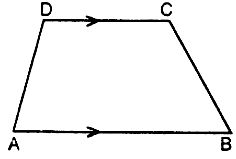
The following figure shows a quadrilateral in which sides AB and DC are parallel. If ∠A : ∠D = 4 : 5, ∠B = (3x – 15)° and ∠C = (4x + 20)°, find each angle of the quadrilateral ABCD.
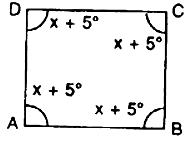
Each angle of a quadrilateral is x + 5°. Find:
(i) the value of x
(ii) each angle of the quadrilateral.
Give the special name of the quadrilateral taken.
In a school, $\frac{4}{5}$ of the students are boys, and the number of girls is $100.$ Find the number of boys.
For an angle x°, find:
(i) the complementary angle
(ii) the supplementary angle
(iii) the value of x° if its supplementary angle is three times its complementary angle.