MCQ
The dimension of rate constant of a second order reaction involves
- ANeither time nor concentration
- BOnly time
- ✓Time and concentration
- DTime and square of concentration
Rate Law for this Reaction is given by : Rate $= k [ A ]^2$
$\because$ Unit of Rate of Reaction is $mol \,litre { }^{-1} \,\sec ^{-1}$ and Unit of Concentration is $mol\, litre ^{-1}$
$\therefore$ Unit of Rate constant is $mol ^{-1}\, litre\,sec ^{-1}$
$\Rightarrow$ Unit of Rate constant is $\left( mol \text { litre }^{-1}\right)^{-1}\, sec ^{-1}$
Unit of Rate constant is $(concentration) { }^{-1} \,\sec ^{-1}$
Generate a complete, print-ready paper with questions like this in minutes — across 16+ boards, with answer keys.
$M{n_{(S)}}|Mn_{(aq)}^{ + 2}(0.4\,M)||Sn_{(aq)}^{ + 2}(0.04\,M)|S{n_{(S)}}$,
Calculate free energy change $(\Delta G)$ at $298\,K$ .
Given :$E_{M{n^{ + 2}}|Mn}^o = \, - \,1.18\,V\,;\,E_{S{n^{ + 2}}|Sn}^o\, = \, - \,0.14\,volt$
$\frac{{2.303\,RT}}{F} = 0.06$
$(1)$ $PtCl_4·5NH_3$ $(2)$ $PtCl_4·4NH_3$
$(3)$ $PtCl4·3NH_3$ $(4)$ $PtCl4·2NH_3$
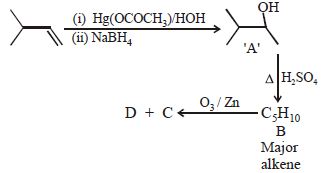
The compound $B$ is