MCQ
The dimensional formula for the modulus of rigidity is
  • A
    $M{L^2}{T^{ - 2}}$
  • B
    $M{L^{ - 1}}{T^{ - 3}}$
  • C
    $M{L^{ - 2}}{T^{ - 2}}$
  • $M{L^{ - 1}}{T^{ - 2}}$

Answer

Correct option: D.
$M{L^{ - 1}}{T^{ - 2}}$
d
(d) Modulus of rigidity = $\frac{{{\rm{Shear}}\;{\rm{stress}}}}{{{\rm{Shear}}\;{\rm{strain}}}} = $ $[M{L^{ - 1}}{T^{ - 2}}]$

Need a full question paper?

Generate a complete, print-ready paper with questions like this in minutes — across 16+ boards, with answer keys.
Start Generating Free

Similar questions

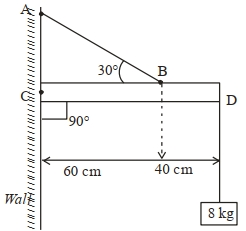
An object of mass $8\,kg$ is hanging from one end of a uniform rod $CD$ of mass $2\,kg$ and length $1\,m$ pivoted at its end $C$ on a vertical wall as shown in figure. It is supported by a cable $A B$ such that the system is in equilibrium. The tension in the cable is $............\,N$ (Take $g=10\,m / s ^2$ )
The angular velocity of a wheel is $70\, rad/sec$. If the radius of the wheel is $0.5\, m$, then linear velocity of the wheel is ....... $m/sec$
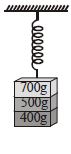
Three masses $700g, 500g$ and $400g$ are suspended at the end of a spring a shown  and are in equilibrium. When the $700g$ mass is removed, the system oscillates with a  period of $3\,seconds$, when the $500g$ mass is also removed, it will oscillate with a period of .... $s$
$A$ block of mass $m$ moving with a velocity $v_0$ on a smooth horizontal surface strikes and compresses a spring of stiffness $k$ till mass comes to rest as shown in the figure. This phenomenon is observed by two observers:

$A$: standing on the horizontal surface

$B$: standing on the block 

To an observer $A$, the work done by spring force is 

A constant force acting on a body of mass of $5\,kg$ changes its speed from $5\,ms^{-1}$ to $10\,ms^{-1}$ in $10\,s$ without changing the direction of motion. The force acting on the body is  ......... $N$
At $0 \;K$ which of the following properties of a gas will be zero
The equation of state of $n$ moles of a non-ideal gas can be approximated by the equation $\left(p+\frac{n^2 \alpha }{V^2}\right)(V-n b)=n R T$ where $a$ and $b$ are constant characteristics of the gas. Which of the following can represent the equation of a quasistatic adiabat for this gas (assume that, $C_V$ is the molar heat capacity at constant volume is independent of temperature)?
A block of ice at $- 10°C$ is slowly heated and converted to steam at $100°C.$ Which of the following curves represents the phenomenon qualitatively
A particle is acted simultaneously by mutually perpendicular simple hormonic motions $\text{x}=\text{a}\cos\omega\text{t}\ \text{and}\ \text{y}=\text{a}\sin\omega\text{t}.$ The trajectory of motion of the particle will be:
  1. An ellipse.
  2. A parabola.
  3. A circle.
  4. A straight line.
The net resistance of a voltmeter should be large to ensure that:
  1. It  does not get overheated.
  2. It does not draw excessive current.
  3. It can measure large potential differences.
  4. It does not appreciably change the potential difference to be measured.