MCQ
The dimensional formula of angular impulse is :
  • A
    $\left[ M L ^{-2} T^{-1}\right]$
  • B
    $\left[ M L ^2 T^{-2}\right]$
  • C
    $\left[ M L T { }^{-1}\right]$
  • D
    $\left[ M L ^2 T^{-1}\right]$

Answer

$\text { Angular impulse }=\text { change in angular momentum. }$
$\text { [Angular impulse }]=[\text { Angular momentum }]=[ mvr ]$
$=\left[ M L ^2 T^{-1}\right]$

Need a full question paper?

Generate a complete, print-ready paper with questions like this in minutes — across 16+ boards, with answer keys.
Start Generating Free

Similar questions

A block is at rest on an inclined plane making an angle $\alpha $ with the horizontal. As the angle $\alpha $ of the incline is increased, the block starts slipping when the angle of inclination becomes $\theta $. The coefficient of static friction between the block and the surface of the inclined plane is 
The radius of gyration of body depends upon
The difference between the apparent frequency of a source of sound as perceived by an observer during its approach and recession is $2\%$ of the natural frequency of the source. If the velocity of sound in air is $300 \,m/sec,$ the velocity of the source is ... $m/sec$ (It is given that velocity of source $<<$ velocity of sound)
What is the path followed by a moving body, on which a constant force acts in a direction other than initial velocity (i.e. excluding parallel and antiparallel direction)?
A bob of mass $m$ attached to an inextensible string of length $l$ is suspended from a vertical support. The bob rotates in a horizontal circle with an angular speed $\omega\ rad/s$ about the vertical. About the point of suspension:
An electric dipole has a fixed dipole moment $\vec P$ which makes angle $\theta $ with respect to $x-$axis. When subjected to an electric field $\overrightarrow {{E_1}} $ $=E$$\hat i$ it experiences a torque $\overrightarrow {{T_1}} $ =$\;\tau \hat k$ When subjected to another electric field $\overrightarrow {{E_2}}  = \sqrt 3 {E_1}\hat j$ it experiences torque $\overrightarrow {{T_2}} $ = $ - \overrightarrow {{T_1}} $ The angle $\theta \;$ is.......$^o$
A plano-convex lens when silvered in the plane side behaves like a concave mirror of focal length $30cm$. However, when silvered on the convex side it behaves like a concave mirror of focal length $10\ cm$. Then the refractive index of its material will be
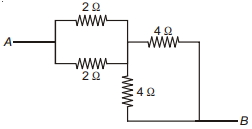
Effective resistance across $A B$ in the network shown in .......... $\Omega$
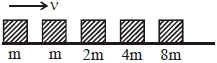
Blocks of masses $m , 2 m , 4 m$ and $8 m$ are arranged in a line on a frictionless floor. Another block of mass $m ,$ moving with speed $v$ along the same line (see figure) ollides with mass $m$ in perfectly inelastic manner. All the subsequent collisions are also perfectly inelastic. By the time the last block of mass $8 m$ starts moving the total energy loss is $p \%$ of the original energy. Value of $'p'$ is close to
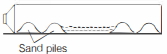
A closed pipe of length $300 \,cm$ contains some sand. A speaker is connected at one of its ends. The frequency of the speaker at which the sand will arrange itself in $20$ equidistant piles is close to .......... $kHz$ (velocity of sound is $300 \,m / s )$