MCQ
The dimensional formula of Avagadro's number is:
  • A
    $\ce{[M^1L^1T^1]}$
  • $\ce{[mole^{-1}]}$
  • C
    $\ce{[mole]}$
  • D
    $\ce{[M^0L^1T^0]}$

Answer

Correct option: B.
$\ce{[mole^{-1}]}$

Need a full question paper?

Generate a complete, print-ready paper with questions like this in minutes — across 16+ boards, with answer keys.

Start Generating Free

Similar questions

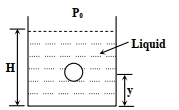
A small spherical monoatomic ideal gas bubble $\left(\gamma=\frac{5}{3}\right)$ is trapped inside a liquid of density $\rho_{\ell}$ (see figure). Assume that the bubble does not exchange any heat with the liquid. The bubble contains n moles of gas. The temperature of the gas when the bubble is at the bottom is $\mathrm{T}_0$, the height of the liquid is $\mathrm{H}$ and the atmospheric pressure is $\mathrm{P}_0$ (Neglect surface tension).

Figure: $Image$

$1.$ As the bubble moves upwards, besides the buoyancy force the following forces are acting on it

$(A)$ Only the force of gravity

$(B)$ The force due to gravity and the force due to the pressure of the liquid

$(C)$ The force due to gravity, the force due to the pressure of the liquid and the force due to viscosity of the liquid

$(D)$ The force due to gravity and the force due to viscosity of the liquid

$2.$ When the gas bubble is at a height $\mathrm{y}$ from the bottom, its temperature is

$(A)$ $\mathrm{T}_0\left(\frac{\mathrm{P}_0+\rho_0 \mathrm{gH}}{\mathrm{P}_0+\rho_t \mathrm{gy}}\right)^{2 / 5}$

$(B)$ $T_0\left(\frac{P_0+\rho_t g(H-y)}{P_0+\rho_t g H}\right)^{2 / 5}$

$(C)$ $\mathrm{T}_0\left(\frac{\mathrm{P}_0+\rho_t \mathrm{gH}}{\mathrm{P}_0+\rho_t \mathrm{gy}}\right)^{3 / 5}$

$(D)$ $T_0\left(\frac{P_0+\rho_t g(H-y)}{P_0+\rho_t g H}\right)^{3 / 5}$

$3.$ The buoyancy force acting on the gas bubble is (Assume $R$ is the universal gas constant)

$(A)$ $\rho_t \mathrm{nRgT}_0 \frac{\left(\mathrm{P}_0+\rho_t \mathrm{gH}\right)^{2 / 5}}{\left(\mathrm{P}_0+\rho_t \mathrm{gy}\right)^{7 / 5}}$

$(B)$ $\frac{\rho_{\ell} \mathrm{nRgT}_0}{\left(\mathrm{P}_0+\rho_{\ell} \mathrm{gH}\right)^{2 / 5}\left[\mathrm{P}_0+\rho_{\ell} \mathrm{g}(\mathrm{H}-\mathrm{y})\right]^{3 / 5}}$

$(C)$ $\rho_t \mathrm{nRgT} \frac{\left(\mathrm{P}_0+\rho_t g \mathrm{H}\right)^{3 / 5}}{\left(\mathrm{P}_0+\rho_t g \mathrm{~g}\right)^{8 / 5}}$

$(D)$ $\frac{\rho_{\ell} \mathrm{nRgT}_0}{\left(\mathrm{P}_0+\rho_{\ell} \mathrm{gH}\right)^{3 / 5}\left[\mathrm{P}_0+\rho_t \mathrm{~g}(\mathrm{H}-\mathrm{y})\right]^{2 / 5}}$

Give the answer question $1,2,$ and $3.$
If radius of earth contracted by $0.1 \%$, its mass remaining same, then weight of the body at earth's surface will increase by ..............$\%$ 
A person brings a mass of $1 \ kg$ from infinity to a point $A .$ Initially the mass was at rest but it moves at a speed of $2 \mathrm{~ms}^{-1}$ as it reaches $A .$ The work done by the person on the mass is $-3 J$ . The potential at $A$ is:
 
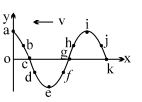
The figure represents the instantaneous picture of a longitudinal harmonic wave travelling along the negative $x$-axis. Identify the correct statement $(s)$ related to the movement of the points shown in the figure. The points of maximum compression are
Two spherical stars $A$ and $B$ emit blackbody radiation. The radius of $A$ is $400$ times that of $B$ and $A$ emits $10^4$ times the power emitted from $B$. The ratio $\left(\lambda_A / \lambda_B\right)$ of their wavelengths $\lambda_A$ and $\lambda_B$ at which the peaks occur in their respective radiation curves is
Three identical vessels are filled with equal masses of three different liquids $A, B$ and $C$   $({\rho _A} > {\rho _B} > {\rho _C})$. The pressure at the base will be
Two gases-argon (atomic radius $0.07 \;\mathrm{nm}$,atomic weight $40$ ) and xenon (atomic radius $0.1\; \mathrm{nm},$ atomic weight $140$ ) have the same number density and are at the same temperature. The raito of their respective mean free times is closest to
A man can jump to a height of $1.5 \,m$ on a planet $A$. What is the height he may be able to jump on another planet whose density and radius are, respectively, one-quarter and one-third that of planet $A$ .......  $m$
If the threshold of hearing is assumed to be the reference $(0\ dB)$ , then the threshold of pain is taken to be $120\ dB$ . Let the corresponding sound intensities be $I_0$ and $I$ respectively. Then $\frac{{{I_0}}}{I}$ is 
The pressure $P$ of a gas and its mean $K.E.$ per unit volume are related as: