MCQ
The dimensional formula of relative density is
  • A
    $M{L^{ - 3}}$
  • B
    $L{T^{ - 1}}$
  • C
    $ML{T^{ - 2}}$
  • Dimensionless

Answer

Correct option: D.
Dimensionless
d
(d) Relative density =$\frac{{{\rm{Density \,of \,substance}}}}{{{\rm{density\, of \,water}}}}$ $ = [{M^0}{L^0}{T^0}]$

Need a full question paper?

Generate a complete, print-ready paper with questions like this in minutes — across 16+ boards, with answer keys.

Start Generating Free

Similar questions

Two particles are projected from the same point with the same speed $u$ such that they have the same range $R$, but different maximum heights, $h_1$ and $h_2$. Which of the following is correct ?
An aluminium sphere of $20 \;cm$ diameter is heated from $0^{\circ} C$ to $100^{\circ} C$. Its volume changes by (given that coefficient of linear expansion for aluminium $\alpha_{A l}=23 \times 10^{-6}\;/{^o}C$
The nature of damped oscillation is:
No work is done by a force on an object if:
  1. The force is always perpendicular to its velocity.
  2. The force is always perpendicular to its acceleration.
  3. The object is stationary but the point of application of the force moves on the object.
  4. The object moves in such a way that the point of application of the force remains fixed.
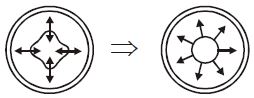
A soap film is formed on a circular frame. A loop of thread is lying on film. If the film inside the loop is broken, then tension in the thread will be : ($R =$ radius of loop, $T =$ surface tension of liquid)
The normal density of a material is $\rho$ and its bulk modulus of elasticity is $K$. The magnitude of increase in density of material, when a pressure $P$ is applied uniformly on all sides, will be
Energy required to form a soap bubble of diameter $20 \,cm$ will be (Surface tension for soap solution is $30$ dynes/cm)
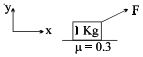
A $\vec F\,\, = \,\,\hat i\, + \,4\hat j\,$ acts on block shown. The force of friction acting on the block is :
The coefficients of thermal expansion of steel and a metal $X$ are respectively $12 × 10^{-6}$ and $2 × 10^{-6} per^o C$. At $40^o C$, the side of a cube of metal $X$ was measured using a steel vernier callipers. The reading was $100 \,\,mm$.Assuming that the calibration of the vernier was done at $0^o C$, then the actual length of the side of the cube at $0^o C$ will be
If the collision frequency of hydrogen molecules in a closed chamber at $27^{\circ} \mathrm{C}$ is $\mathrm{Z}$, then the collision frequency of the same system at $127^{\circ} \mathrm{C}$ is :