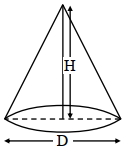
The dimensions of a cone are measured using a scale with a least count of $2 mm$. The diameter of the base and the height are both measured to be $20.0 cm$. The maximum percentage error in the determination of the volume is. . . . .
IIT 2024, Easy


Download our appand get started for free
Experience the future of education. Simply download our apps or reach out to us for more information. Let's shape the future of learning together!No signup needed.*
Similar Questions
- 1$10\; amu =$ ……..$kg$View Solution
- 2View SolutionThe value of Planck's constant is
- 3The mass of the body is $10.000\,g$ and its volume is $10.00\,cm^3$. If the measured values are expressed upto the correct significant figures, the maximum error in the measurement of density isView Solution
- 4View SolutionDimensional formula for volume elasticity is
- 5If momentum $[ P ]$, area $[ A ]$ and time $[ T ]$ are taken as fundamental quantities, then the dimensional formula for coefficient of viscosity is :View Solution
- 6If e is the electronic charge, $c$ is the speed of light in free space and $h$ is Planck's constant, the quantity $\frac{1}{4 \pi \varepsilon_{0}} \frac{| e |^{2}}{h c}$ has dimensions of .......View Solution
- 7Match List $I$ with List $II$View Solution
LIST$-I$ LIST$-II$ $(A)$ Surface tension $(I)$ $Kg m ^{-1} s ^{-1}$ $(B)$ Pressure $(II)$ $Kg ms^{-1 }$ $(C)$ Viscosity $(III)$ $Kg m ^{-1} s ^{-2}$ $(D)$ Impulse $(IV)$ $Kg s ^{-2}$ Choose the correct answer from the options given below :
- 8A thin copper wire of length l metre increases in length by $ 2\%$ when heated through $10^o C$. ......... $\%$ is the percentage increase in area when a square copper sheet of length $l$ metre is heated through $10^o C$View Solution
- 9The temperatures of two bodies measured by a thermometer are $t_{1}=20^{\circ} C \pm 0.5^{\circ} C$ and $t_{2}=50^{\circ} C \pm 0.5^{\circ} C$ Calculate the temperature difference and the error theirin.View Solution
- 10Assertion : The error in the measurement of radius of the sphere is $0.3\%$. The permissible error in its surface area is $0.6\%$View Solution
Reason : The permissible error is calculated by the formula $\frac{{\Delta A}}{A} = \frac{{4\Delta r}}{r}$