MCQ
The dimensions of impulse are equal to that of
  • Momentum
  • B
    Force
  • C
    Angular momentum
  • D
    Torque

Answer

Correct option: A.
Momentum
a
(a) Momentum = $mv = [ML{T^{ - 1}}]$

Impulse = Force $ \times $ Time

= $[ML{T^{ - 2}}] \times [T] = [ML{T^{ - 1}}]$

Need a full question paper?

Generate a complete, print-ready paper with questions like this in minutes — across 16+ boards, with answer keys.
Start Generating Free

Similar questions

Equation of a progressive wave is given by $y = 4\sin \left\{ {\pi \left( {\frac{t}{5} - \frac{x}{9}} \right) + \frac{\pi }{6}} \right\}$. Then which of the following is correct
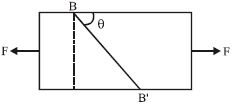
A bar of cross-sectional area $A$ is subjected two equal and opposite tensile forces at its ends as shown in figure. Consider a plane $BB'$ making an angle $\theta $ with the length The ratio of tensile stress to the shearing stress on the plane $BB'$ is
Assuming the coefficient of friction between the road and tyres of a car to be $0.5$, the maximum speed with which the car can move round a curve of $40.0\, m$ radius without slipping, if the road is unbanked, should be ......... $m/s$
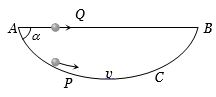
A particle $P$ is sliding down a frictionless hemispherical bowl. It passes the point $A$ at $t = 0$. At this instant of time, the horizontal component of its velocity is $v$. A bead $Q$ of the same mass as $P$ is ejected from $A$ at $t = 0$ along the horizontal string $AB$ (see figure) with the speed $v$. Friction between the bead and the string may be neglected. Let ${t_P}$ and ${t_Q}$ be the respective time taken by $P$ and $Q$ to reach the point $B$. Then
Consider two uniform discs of the same thickness and different radii $R _{1}= R$ and $R _{2}=\alpha R$ made of the same material. If the ratio of their moments of inertia $I_{1}$ and $I_{2}$, respectively, about their axes is $I _{1}: I _{2}=1: 16$ then the value of $\alpha$ is
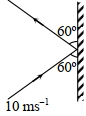
A body of mass $3\, kg$ hits a wall at an angle of $60^o$ and returns at the same angle. The impact time was $0.2 \;.s$ Calculate the force exerted on the wall
It is estimated that per minute each $cm^2$ of earth receives about $2\ cal (1\ cal = 4.18\ J)$ of heat energy from the sun. This is called Solar constant. In $SI$ units the value is :-
A person standing near the edge of the top of a building throws two balls A and B. The ball A is thrown vertically upward and B is thrown vertically downward with the same speed. The ball A hits the ground with a speed vA and the ball B hits the ground with a speed vB. We have:
  1. vA > vB
  2. vA < vB
  3. vA = vB
  4. The relation between vand vB depends on height of the building above the ground.
Four particles each of mass $m$ are placed at the corners of a square of side length $l.$  The radius of gyration of the system about an axis perpendicular to the square and passing through its centre is   
A ball is thrown up vertically with a certain velocity so that, it reaches a maximum height $h$. Find the ratio of the times in which it is at height $\frac{ h }{3}$ while going up and coming down respectively.