MCQ
The dimensions of surface tension are
  • A
    $M{L^{ - 1}}{T^{ - 2}}$
  • B
    $ML{T^{ - 2}}$
  • C
    $M{L^{ - 1}}{T^{ - 1}}$
  • $M{T^{ - 2}}$

Answer

Correct option: D.
$M{T^{ - 2}}$
d
(d) Surface tension = $\frac{{{\rm{Force}}}}{{{\rm{Length}}}} = \frac{{[ML{T^{ - 2}}]}}{L} = [M{T^{ - 2}}]$

Need a full question paper?

Generate a complete, print-ready paper with questions like this in minutes — across 16+ boards, with answer keys.
Start Generating Free

Similar questions

Find moment of inertia of a uniform annular disc of mass $100 \,g$, having inner radius $10\, cm$ and outer radius $20\, cm$, about an axis passing through its centre and perpendicular to its plane.
The force constant of a wire is $k$ and that of another wire is $2k$. When both the wires are stretched through same distance, then the work done
A block of mass $1\, kg$ is at rest on a horizontal table. The coefficient of static friction  between the block and the table is $0.5.$ The magnitude of the force acting upwards at  an angle of $60^o$ from the horizontal that will just start the block moving is
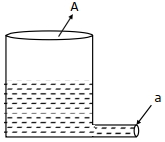
A light cylindrical vessel is kept on a horizontal surface. Area of base is A. A hole of crosssectional area $'a'$ is made just at its bottom side. The minimum coefficient of friction necessary to prevent sliding the vessel due to the impact force of the emerging liquid is $(a\,<\,<\,A)$
A cricketer can throw a ball to a maximum horizontal distance of $100\, m$. The speed with which he throws the ball is   ......... $ms^{-1}$ (to the nearest integer)
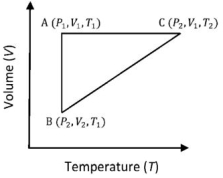
A reversible cyclic process for an ideal gas is shown below. Here, $P, V$, and $T$ are pressure, volume and temperature, respectively. The thermodynamic parameters $q, w, H$ and $U$ are heat, work, enthalpy and internal energy, respectively.

(image)

The correct option ($s$) is (are)

$(A)$ $q_{A C}=\Delta U_{B C}$ and $W_{A B}=P_2\left(V_2-V_1\right)$

$(B)$ $\mathrm{W}_{\mathrm{BC}}=\mathrm{P}_2\left(\mathrm{~V}_2-\mathrm{V}_1\right)$ and $\mathrm{q}_{\mathrm{BC}}=\mathrm{H}_{\mathrm{AC}}$

$(C)$ $\Delta \mathrm{H}_{\mathrm{CA}}<\Delta \mathrm{U}_{\mathrm{CA}}$ and $\mathrm{q}_{\mathrm{AC}}=\Delta \mathrm{U}_{\mathrm{BC}}$

$(D)$ $\mathrm{q}_{\mathrm{BC}}=\Delta \mathrm{H}_{\mathrm{AC}}$ and $\Delta \mathrm{H}_{\mathrm{CA}}>\Delta \mathrm{U}_{\mathrm{CA}}$
A mixture of gases undergoing explosive chemical reaction:
A particle executes a simple harmonic motion of time period $T$. Find the time taken by the particle to go directly from its mean position to half the amplitude
The position vector of a particle $\vec R$ as a function of time is given by $\overrightarrow {\;R} = 4\sin \left( {2\pi t} \right)\hat i + 4\cos \left( {2\pi t} \right)\hat j$ where $R$ is in meters, $t$ is in seconds and  $\hat i$ and $\hat j$  denote unit vectors along $x-$ and $y-$directions, respectively. Which one of the following statements is wrong for the motion of particle? 
A solid sphere is rolling on a horizontal plane without slipping. If the ratio of angular momentum about axis of rotation of the sphere to the total energy of moving sphere is $\pi: 22$ then, the value of its angular speed will be $...........\,rad / s$.