MCQ
The dimensions of surface tension are
  • A
    $[ML{T^{ - 1}}]$
  • B
    $[M{L^2}{T^{ - 2}}]$
  • $[M{L^0}{T^{ - 2}}]$
  • D
    $[M{L^{ - 1}}{T^{ - 2}}]$

Answer

Correct option: C.
$[M{L^0}{T^{ - 2}}]$
c
(c)$T = \frac{F}{l} = \frac{{[ML{T^{ - 2}}]}}{{[L]}} = [M{L^0}{T^{ - 2}}]$

Need a full question paper?

Generate a complete, print-ready paper with questions like this in minutes — across 16+ boards, with answer keys.

Start Generating Free

Similar questions

If $v$ is the velocity of a body moving along $x$-axis, then acceleration of body is .........
$Y $ component of velocity is $20$ and $X$ component of velocity is $10$. The direction of motion of the body with the horizontal at this instant is
A drop of mercury of radius $2\, mm$ is split into $8$ identical droplets. Find the increase in surface energy ....... $\mu J$. (Surface tension of mercury is $0.465\;J/{m^2}$)
The angular frequency of the damped oscillator is given by, $\omega  = \sqrt {\left( {\frac{k}{m} - \frac{{{r^2}}}{{4{m^2}}}} \right)} $ where $k$ is the spring constant, $m$ is the mass of the oscillator and $r$ is the damping constant. If the ratio $\frac{{{r^2}}}{{mk}}$ is $8\%$, the change in time period compared to the undamped oscillator is approximately as follows
What is the minimum energy required to launch a satellite of mass $m$ from the surface of a planet of mass $M$ and radius $R$ in a circular orbit at an altitude of $2R$?
A real gas behaves like an ideal gas if its
If the gravitational force between two objects were proportional to $\frac{1}{R}$ (and not as $1/{R^2})$ where $R$ is separation between them, then a particle in circular orbit under such a force would have its orbital speed $v$ proportional to
A wire of length $L$ and mass per unit length $6.0\times 10^{-3}\; \mathrm{kgm}^{-1}$ is put under tension of $540\; \mathrm{N}$. Two consecutive frequencies that it resonates at are : $420\; \mathrm{Hz}$ and $490 \;\mathrm{Hz}$. Then $\mathrm{L}$ in meters is
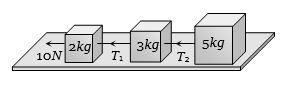
Three blocks of masses $2 \,kg, 3 \,kg$ and $5\, kg$ are connected to each other with light string and are then placed on a frictionless surface as shown in the figure. The system is pulled by a force $F = 10N,$ then tension ${T_1} = $  .......... $N$ 
A mass $m =100\, gms$ is attached at the end of a light spring which oscillates on a frictionless horizontal table with an amplitude equal to $0.16$ metre and time period equal to $2 \,sec$. Initially the mass is released from rest at $t = 0$ and displacement $x = - 0.16$ metre. The expression for the displacement of the mass at any time $t$ is