MCQ
The displacement at point P by two light waves emitted from this light source is $Y _1=5 \sin \omega t$ and $Y _2$ $=3 \cos \omega t$ respectively, then both the waves will be :
  • A
    Non-Coherent
  • Coherent
  • C
    Partial Coherent
  • D
    Can't say anything.

Answer

Correct option: B.
Coherent
(B) - Coherent.

Need a full question paper?

Generate a complete, print-ready paper with questions like this in minutes — across 16+ boards, with answer keys.
Start Generating Free

Similar questions

In $LCR$ series circuit source voltage is $120$ volt and voltage in inductor $50$ volt and resistance is $40$ volt, then determine voltage in capacitor.
With a change of load resistance of a triode, used as an amplifier, from 50 kilo ohms to 100 kilo ohms, its voltage amplification changes from 25 to 30. Plate resistance of the triode is
Out of the following, which colour's wavelength is more than the wavelength of yellow colour?
Intensity of X-rays depends upon the number of
Suppose we consider a large number of containers each containing initially $10000$ atoms of a radioactive material with a half life of $1$ year. After $1$ year:
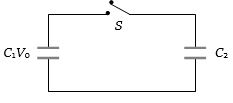
A capacitor of capacity ${C_1}$ is charged to the potential of ${V_o}$. On disconnecting with the battery, it is connected with a capacitor of capacity ${C_2}$ as shown in the adjoining figure. The ratio of energies before and after the connection of switch $S$ will be
$100$ capacitors each having a capacity of $10\,\mu F$ are connected in parallel and are charged by a potential difference of $100\,kV$. The energy stored in the capacitors and the cost of charging them, if electrical energy costs $108\;paise\;per\;kWh$, will be
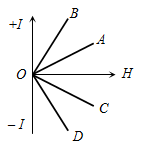
The variation of the intensity of magnetisation (I) with respect to the magnetising field (H) in a diamagnetic substance is described by the graph
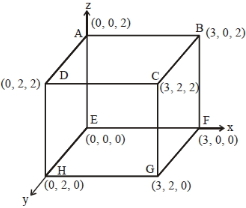
An electric field $\overrightarrow{\mathrm{E}}=4 \mathrm{x} \hat{\mathrm{i}}-\left(\mathrm{y}^{2}+1\right) \hat{\mathrm{j}}\; \mathrm{N} / \mathrm{C}$ passes through the box shown in figure. The flux of the electric field through surfaces $A B C D$ and $BCGF$ are marked as $\phi_{I}$ and $\phi_{\mathrm{II}}$ respectively. The difference between $\left(\phi_{\mathrm{I}}-\phi_{\mathrm{II}}\right)$ is (in $\left.\mathrm{Nm}^{2} / \mathrm{C}\right)$
A bar magnet is oscillating in the Earth’s magnetic field with a period T. What happens to its period and motion if its mass is quadrupled