MCQ
The displacement of a particle in $\text{SHM}$ varies according to the relation $\text{x}=4(\cos\pi\text{t}+\sin\pi\text{t})$ The amplitude of the particle is:
  • A
    $-4$
  • B
    $4$
  • $4\sqrt{2}$
  • D
    $8$

Answer

Correct option: C.
$4\sqrt{2}$
Given equation $\text{x(t)}=4(\cos\pi\text{t}+\sin\pi\text{t})$
Now comparing cbove equation with general form $\text{x(t)}=\text{A}\cos\omega\text{t}+\text{B}\sin\omega\text{t}$
We get $A = 4$ and $B = 4$
As, the resultant amplitude for such a equation is
$=\sqrt{\text{A}^2+\text{B}^2}$
$\therefore$ Amplitude $=\sqrt{4^2+4^2}=4\sqrt{2}$

Need a full question paper?

Generate a complete, print-ready paper with questions like this in minutes — across 16+ boards, with answer keys.
Start Generating Free

Similar questions

An electric pump is used to fill an overhead tank of capacity $9\,m^3$ kept at a height of $10\,m$ above the ground. If the pump takes $5\,minutes$ of fill the tank by consuming $10\, kW$ power, the efficiency of the pump should be : ............... $\%$ (Take $g = 10\,ms^2$ )
A man throws balls with the same speed vertically upwards one after the other at an interval of $2$ second. What should be the speed of the throw so that more than two balls are in sky at any time? $($Given $g = 9.8\ m/ s^2)$
A particle performs $SHM$ about $x = 0$ such that at $t = 0$ it is at $x = 0$ and moving towards positive extreme. The time taken by it to go from $x = 0$ to $x = \frac{A}{2}$ is ..... times the time taken to go from $x = \frac{A}{2}$ to $A$. The most suitable option for the blank space is
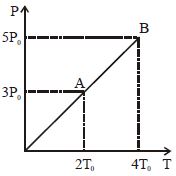
Pressure $Vs$ temperature graph of an ideal gas is shown in figure. Density of the gas at point $A$ is $\rho _0$ , Density at $B$ will be
$5.6$ liter of helium gas at $STP$ is adiabatically compressed to $0.7$ liter. Taking the initial temperature to be $T _1$, the work done in the process is
A body is thrown up in a lift with a velocity $u$ relative to the lift and the time of flight is found to be $ t.$ The acceleration with which the lift is moving up is
A blackbody does not:
$1$ mole of $H _2$ gas is contained in a box of volume $V =1.00 m^3$ at $T =300 K$. The gas is heated to a temperature of $T =3000 K$ and the gas gets converted to a gas of hydrogen atoms. The final pressure would be $($considering all gases to be ideal$).$
In the elastic collision of objects
$100 \,gm$ of ice at $0°C$ is mixed with $100\, g$ of water at $100°C.$ What will be the final temperature of the mixture .......... $^oC$