MCQ
The displacement of a particle is given by $y = a + bt + c{t^2} - d{t^4}$. The initial velocity and acceleration are respectively
- A$b,\, - 4d$
- B$ - b,\,2c$
- ✓$b,\,2c$
- D$2c,\, - 4d$
$\therefore \;v = \frac{{dy}}{{dt}} = b + 2ct - 4d{t^3}$ and $a = \frac{{dv}}{{dt}} = 2c - 12d{t^2}$
Hence, at $t = 0$, $v_{initial} \,= b$ and $a_{initial}$ $= 2c$.
Generate a complete, print-ready paper with questions like this in minutes — across 16+ boards, with answer keys.
$(A)$ $E_1 \omega_1=E_2 \omega_2$ $(B)$ $\frac{\omega_2}{\omega_1}=n^2$ $(C)$ $\omega_1 \omega_2= n ^2$ $(D)$ $\frac{E_1}{\omega_1}=\frac{E_2}{\omega_2}$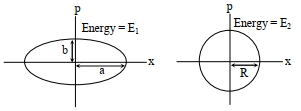
$\left[\right.$ Take $\left.g =10\,m / s ^{2}\right]$