The displacement of a particle varies with time as $x = 12\sin \omega t - 16{\sin ^3}\omega t$ (in $cm$). If its motion is $S.H.M.$, then its maximum acceleration is
Medium
Download our app for free and get started
(b) $x = 12\sin \omega \,t - 16\,{\sin ^3}\omega \,t = 4[3\sin \omega \,t - 4{\sin ^3}\omega \,t]$
$ = 4[\sin 3\omega \,t]$ (By using $\sin 3\theta = 3\sin \theta - 4{\sin ^3}\theta )$
$\therefore $ maximum acceleration ${A_{\max }} = {(3\omega )^2} \times 4 = 36{\omega ^2}$

Download our appand get started for free
Experience the future of education. Simply download our apps or reach out to us for more information. Let's shape the future of learning together!No signup needed.*
Similar Questions
- 1A spring has a certain mass suspended from it and its period for vertical oscillation is $T$. The spring is now cut into two equal halves and the same mass is suspended from one of the halves. The period of vertical oscillation is nowView Solution
- 2Two particles are in $SHM$ on same straight line with amplitude $A$ and $2A$ and with same angular frequency $\omega .$ It is observed that when first particle is at a distance $A/\sqrt{2}$ from origin and going toward mean position, other particle is at extreme position on other side of mean position. Find phase difference between the two particlesView Solution
- 3If the length of simple pendulum is increased by $300\%$, then the time period will be increased by ..... $\%$View Solution
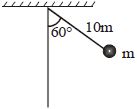
- 4View SolutionIf pendulum is released from given position find velocity of Bob when it reaches the lowest position
- 5A body executes simple harmonic motion. The potential energy $(P.E.)$, the kinetic energy $(K.E.)$ and total energy $(T.E.)$ are measured as a function of displacement $x$. Which of the following statements is trueView Solution
- 6Time period of a simple pendulum in a stationary lift is ' $T$ '. If the lift accelerates with $\frac{ g }{6}$ vertically upwards then the time period will be .....View Solution
(where $g =$ acceleration due to gravity)
- 7A simple pendulum is set up in a trolley which moves to the right with an acceleration a on a horizontal plane. Then the thread of the pendulum in the mean position makes an angle $\theta $ with the verticalView Solution
- 8The equation of a simple harmonic motion is $X = 0.34\cos (3000t + 0.74)$ where $X$ and $t$ are in $mm$ and $sec$. The frequency of motion isView Solution
- 9The displacement of a particle is represented by the equation $y = sin^3\,\,\,\omega t$ . The motion isView Solution
- 10View SolutionTo make the frequency double of an oscillator, we have to