MCQ
The displacement of an object attached to a spring and executing simple harmonic motion is given by $ x= 2 \times 10^{-9}$ $ cos$ $\;\pi t\left( m \right)$ .The time at which the maximum speed first occurs is
  • A
    $0.25$
  • $0.5$
  • C
    $0.75$
  • D
    $0.125$

Answer

Correct option: B.
$0.5$
b
Here, $x=2 \times 10^{-2} \cos \pi t$

$\therefore v=\frac{d x}{d t}=2 \times 10^{-2} \pi \sin \pi t$

For the first time, the speed to be maximum,

$\sin \pi t=1$ or, $\sin \pi t=\sin \frac{\pi}{2}$

$\Rightarrow \pi t=\frac{\pi}{2} \quad$ or, $t=\frac{1}{2}=0.5 \mathrm{sec}$

Need a full question paper?

Generate a complete, print-ready paper with questions like this in minutes — across 16+ boards, with answer keys.
Start Generating Free

Similar questions

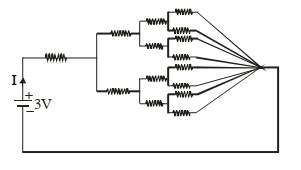
All resistances in figure are $1\,\Omega$ each. The value of current ' $I$ ' is $\frac{a}{5}\,A$. The value of $a$ is
A circular metallic ring of radius $R$ has a small gap of width $d$. The coefficient of thermal expansion of the metal is $\alpha$ in appropriate units. If we increase the temperature of the ring by an amount $\Delta T$, then width of the gap
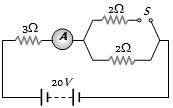
In the circuit shown, the reading of ammeter when switch $S$ is open and when switch $S$ is closed respectively are
Escape velocity on the earth
A proton of velocity $\left( {3\hat i + 2\hat j} \right)\,ms^{-1}$ enters a magnetic field of  $(2\hat j + 3\hat k)\, tesla$. The acceleration produced in the proton is (charge to mass ratio of proton $= 0.96 \times10^8\,Ckg^{-1}$)
Which of the following is the unit vector perpendicular to $\overrightarrow A $ and $\overrightarrow B $
A Carnot engine, whose efficiency is $40\%$, takes in heat from a source maintained at a temperature of $500\ K$. It is desired to have an engine of efficiency $60\%$. Then, the intake temperature for the same exhaust (sink) temperature must be ....... $K$
Two identical circular loops are moving with same kinetic energy one rolls $\&$ other slides. The ratio of their speed is 
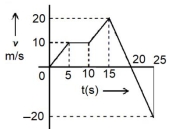
From the $v$ - $t$ graph shown. the ratio of distance to displacement in $25\,s$ of motion
In a semiconductor,
$(i)$ there are no free electrons at $0\, K$
$(ii)$ there are no free electrons at any temperature
$(iii)$the number of free electrons increases with temperature
$(iv)$ the number of free electrons is less than that in a conductor