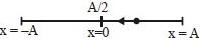
The displacement time equation of a particle executing $SHM$ is : $x = A \,sin\,(\omega t + \phi )$. At time $t = 0$ position of the particle is $x = A/2$ and it is moving along negative $x-$ direction. Then the angle $\phi $ can be
Medium


Download our appand get started for free
Experience the future of education. Simply download our apps or reach out to us for more information. Let's shape the future of learning together!No signup needed.*
Similar Questions
- 1Two particles execute $SHM$ of same amplitude of $20\, cm$ with same period along the same line about the same equilibrium position. The maximum distance between the two is $20\, cm.$ Their phase difference in radians isView Solution
- 2A particle executing simple harmonic motion along $Y- $axis has its motion described by the equation $y = A\sin (\omega \,t) + B$. The amplitude of the simple harmonic motion isView Solution
- 3View SolutionThe equation of simple harmonic motion may not be expressed as (each term has its usual meaning)
- 4Astone is swinging in a horizontal circle $0.8\, m$ in diameter at $30 \,rev / min.$ Adistant horizontal light beam causes a shadow of the stone to be formed on a nearly vertical wall. The amplitude and period of the simple harmonic motion for the shadow of the stone areView Solution
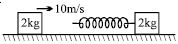
- 5A $2\, Kg$ block moving with $10\, m/s$ strikes a spring of constant $\pi ^2 N/m$ attached to $2\, Kg$ block at rest kept on a smooth floor, the velocity of the rear $2\, kg$ block after it separates from the spring will be ..... $m/s$View Solution
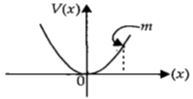
- 6A particle of mass $m$ is released from rest and follows a parabolic path as shown. Assuming that the displacement of the mass from the origin is small, which graph correctly depicts the position of the particle as a function of time $?$View Solution
- 7$Assertion :$ In simple harmonic motion, the velocity is maximum when the acceleration is minimum.View Solution
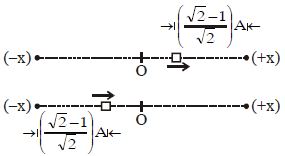
$Reason :$ Displacement and velocity of $S.H.M.$ differ in phase by $\frac{\pi }{2}$ - 8Two bodies performing $SHM$ have same amplitude and frequency. Their phases at a certain instant are as shown in the figure. The phase difference between them isView Solution
- 9The angular velocity and the amplitude of a simple pendulum is $\omega $ and $a$ respectively. At a displacement $X$ from the mean position if its kinetic energy is $T$ and potential energy is $V$, then the ratio of $T$ to $V$ isView Solution
- 10A point performs simple harmonic oscillation of period $T$ and the equation of motion is given by $x=Asin$$\left( {\omega t + \frac{\pi }{6}} \right)$. After the elapse of what fraction of the time period the velocity of the point will be equal to half of its maximum velocity?View Solution