MCQ
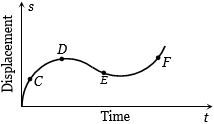
The displacement-time graph of moving particle is shown below. The instantaneous velocity of the particle is negative at the point
  • A
    $D$
  • B
    $F$
  • C
    $C$
  • $E$

Answer

Correct option: D.
$E$
d
(d)Slope of displacement time graph is negative only at point $E$.

Need a full question paper?

Generate a complete, print-ready paper with questions like this in minutes — across 16+ boards, with answer keys.
Start Generating Free

Similar questions

A sudden drop in the mercury level by $10 \,mm$ or more is a sign of ..........
$50\, gm$ of copper is heated to increase its temperature by $10^oC$. If the same quantity of heat is given to $10\; gm$ of water, the rise in its temperature is ........ $^oC$ (Specific heat of copper $= 420 \;Joule-kg^{-1} {°C^{-1}}$)
If the Bulk modulus of lead is $8.0 \times 10^9 \,N / m ^2$ and the initial density of the lead is $11.4 \,g / cc$, then under the pressure of $2.0 \times 10^8 \,N / m ^2$, the density of the lead is ............. $g / cc$
A particle moves in a straight line with retardation proportional to its displacement. Its loss of kinetic energy for any displacement $x$  is proportional to
In order to shift a body of mass $m$ from a circular orbit of radius $3R$ to a higher radius $5R$ around the earth, the work done is
The rate of recombination or generation are governed by the law(s) of
A stone thrown down with a speed $u$ takes a time $t_1$ to reach the ground, while another stone thrown upwards from the same point with the same speed takes time $t_2$. The maximum height the second stone reaches from the ground is
Water rises in a vertical capillary tube upto a length of 10cm. If the tube is inclined at 45°, the length of water risen in the tube will be:
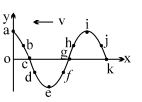
The figure represents the instantaneous picture of a longitudinal harmonic wave travelling along the negative $x$-axis. Identify the correct statement $(s)$ related to the movement of the points shown in the figure. The points moving in the direction of wave are
A steam boat goes across a lake and comes back $(a)$ On a quite day when the water is still and $(b)$ On a rough day when there is uniform air current so as to help the journey onward and to impede the journey back. If the speed of the launch on both days was same, in which case it will complete the journey in lesser time