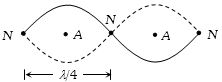
The distance between the nearest node and antinode in a stationary wave is
Easy
Download our app for free and get started
The distance between the nearest node and antinode in a stationary wave is $\frac{\lambda }{4}$

Download our appand get started for free
Experience the future of education. Simply download our apps or reach out to us for more information. Let's shape the future of learning together!No signup needed.*
Similar Questions
- 1The frequency of echo will be $.......Hz$ if the train blowing a whistle of frequency $320\,Hz$ is moving with a velocity of $36\,km / h$ towards a hill from which an echo is heard by the train driver. Velocity of sound in air is $330\,m / s$.View Solution
- 2The equation of a standing wave in a string fixed at both ends is given as $y=2 A \sin k x \cos \omega t$ The amplitude and frequency of a particle vibrating at the mid of an antinode and a node are respectivelyView Solution
- 3A transverse wave is represented by $y=2 \sin$ $(\omega t - kx ) cm$. The value of wavelength (in $cm$ ) for which the wave velocity becomes equal to the maximum particle velocity, will be.View Solution
- 4Two sound waves of intensity $2 \,W / m ^2$ and $3 \,W / m ^2$ meet at a point to produce a resultant intensity $5 \,W / m ^2$. The phase difference between two waves is ......View Solution
- 5In a resonance tube the first resonance with a tuning fork occurs at $16 cm$ and second at $49 cm.$ If the velocity of sound is $330 m/s,$ the frequency of tuning fork isView Solution
- 6A closed organ pipe $150 \mathrm{~cm}$ long gives $7$ beats per second with an open organ pipe of length $350 \mathrm{~cm}$, both vibrating in fundamental mode. The velocity of sound is_________ $\mathrm{m} / \mathrm{s}$.View Solution
- 7If two tuning forks $A$ and $B$ are sounded together, they produce $4$ beats per second. $A$ is then slightly loaded with wax, they produce $2$ beats when sounded again. The frequency of $A$ is $256.$ The frequency of $B$ will beView Solution
- 8In the resonance tube experiment, first resonant length is $l_1$ and second resonant length is $l_2$ then the third resonant length will beView Solution
- 9An organ pipe of length $L$ is open at one end and closed at other end. The wavelengths of the three lowest resonating frequencies that can be produced by this pipe areView Solution
- 10Two identical straight wires are stretched so as to produce $6$ beats per second when vibrating simultaneously. On changing the tension in one of them, the beat frequency remains unchanged. Denoting by ${T_1},\,{T_2}$, the higher and the lower initial tensions in the strings, then it could be said that while making the above change in tensionView Solution