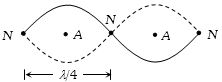
MCQ
The distance between the nearest node and antinode in a stationary wave is
  • A
    $\lambda$
  • B
    $\frac{\lambda }{2}$
  • $\frac{\lambda }{4}$
  • D
    $2\lambda$

Answer

Correct option: C.
$\frac{\lambda }{4}$
c
The distance between the nearest node and antinode in a stationary wave is $\frac{\lambda }{4}$

Need a full question paper?

Generate a complete, print-ready paper with questions like this in minutes — across 16+ boards, with answer keys.
Start Generating Free

Similar questions

Consider a car moving along a straight horizontal road with a speed of $72\, km/h$. If the coefficient of kinetic friction between the tyres and the road is $0.5,$ the shortest distance in which the car can be stopped is ........ $m$ .$[g = 10\,m{s^{ - 2}}]$
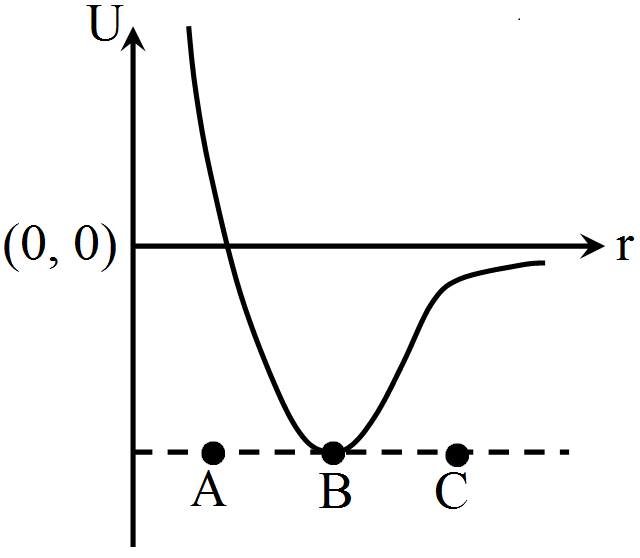
The potential energy $U$ between two molecules as a function of the distance $r$ between them has been shown in the adjoining figure. The two molecules are:
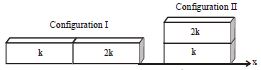
Two rectangular blocks, having identical dimensions, can be arranged either in configuration $I$ or in configuration $II$ as shown in the figure. One of the blocks has thermal conductivity $k$ and the other $2k$. The temperature difference between the ends along the $x-$ axis is the same in both the configurations. It takes $9s$ to transport a certain amount of heat from the hot end to the cold end in the configuration $I$. The time to transport the same amount of heat in the configuration $II$ is .......... $\sec$
Assertion : The equivalent thermal conductivity of two plates of same thickness in contact is less than the smaller value of thermal conductivity.
Reason : For two plates of equal thickness in contact the equivalent thermal conductivity is given by : $\frac{1}{K} = \frac{1}{{{K_1}}} + \frac{1}{{{K_2}}}$
A hot body, obeying Newton's law of cooling is cooling down from its peak value $80\,^oC$ to an ambient temperature of $30\,^oC$ . It takes $5\, minutes$ in cooling down from $80\,^oC$ to $40\,^oC$.  ........  $\min.$ will it take to cool down from $62\,^oC$ to $32\,^oC$ ? (Given $ln\, 2\, = 0.693, ln\, 5\, = 1.609$)
A man is slipping on a frictionless inclined plane and a bag falls down from the same height. Then the velocity of both is related as
When two progressive waves $\mathrm{y}_1=4 \sin (2 \mathrm{x}-6 \mathrm{t})$ and $\mathrm{y}_2=3 \sin \left(2 \mathrm{x}-6 \mathrm{t}-\frac{\pi}{2}\right)$ are superimposed, the amplitude of the resultant wave is
The extension of a wire by the application of load is $3$ $mm.$ The extension in a wire of the same material and length but half the radius by the same load is..... $mm$
When temperature of an ideal gas is increased from $27^\circ C$ to $227^\circ C$, its $r.m.s.$ speed changed from $400\, metre/sec$ to ${V_s}.$ The ${V_s}$ is ........ $metre/sec$
A bomb is projected with $200\,m/s$ at an angle $60^o$ with horizontal. At the highest  point, it explodes into three particles of equal masses. One goes vertically upward with  velocity $100\,m/sec$, second particle goes vertically downward with the same velocity as  the first. Then what is the velocity of the third one-