MCQ
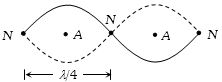
The distance between the nearest node and antinode in a stationary wave is
  • A
    $\lambda$
  • B
    $\frac{\lambda }{2}$
  • $\frac{\lambda }{4}$
  • D
    $2\lambda$

Answer

Correct option: C.
$\frac{\lambda }{4}$
c
The distance between the nearest node and antinode in a stationary wave is $\frac{\lambda }{4}$

Need a full question paper?

Generate a complete, print-ready paper with questions like this in minutes — across 16+ boards, with answer keys.
Start Generating Free

Similar questions

A small object of uniform density rolls up a curved surface with an initial velocity v'. If reaches up to a maximum height of $\frac{3 v^2}{4 g}$ with respect to the initial position. The object is
Two guns $A$ and $B$ can fire bullets at speed $1\, km/s$ and $2\, km/s$ respectively. From a point on a horizontal ground, they are fired in all possible directions. The ratio of maximum areas covered by the bullets fired by the two guns, on the ground is
Assuming the earth to be a sphere of uniform mass density, the weight of a body at a depth $d=\frac{R}{2}$ from the surface of earth, if its werght on the surface of earth is $200\,N$, will be $...........\,N$ ( $Given R =$ Radrus of earth)
A body is projected from earth's surface to become its satellite. Its time period of revolution will not depend upon:
The position-time graph for a body moving along a straight line between $O$ and $A$ is shown in figure. During its motion between $O$ and $A$, how many times body comes to rest?
An open pipe of length $33\,cm$ resonates to a frequency of $1000\,Hz$ . The mode of vibration is: (velocity of sound $= 330\,m/s$ )
A hot air balloon is carrying some passengers, and a few sandbags of mass $1 kg$ each so that its total mass is $480 kg$. Its effective volume giving the balloon its buoyancy is $V$. The balloon is floating at an equilibrium height of $100 m$. When $N$ number of sandbags are thrown out, the balloon rises to a new equilibrium height close to $150 m$ with its volume $V$ remaining unchanged. If the variation of the density of air with height $h$ from the ground is $\rho(h)=\rho_0 e^{-\frac{h}{h_0}}$, where $\rho_0=1.25 kg m ^{-3}$ and $h _0=6000 m$, the value of $N$ is. . . . . 
A man is standing in a lift which goes up and comes down with the same constant acceleration. If the ratio of the apparent weights in the two cases is $2 : 1$, then the acceleration of the lift is  ......... $m/s^2$
A man of mass $m$ starts falling towards a planet of mass $M$ and radius $R.$ As he reaches near to the surface, he realizes that he will pass through a small hole in the planet. As he enters the hole, he sees that the planet is really made of two pieces a spherical shell of negligible thickness of mass $\frac{2M}{3}$ and a point  mass $\frac{M}{3}$ at the centre. Change in the force of gravity experienced by the man is
How much work to be done in decreasing the volume of and ideal gas by an amount of $2.4 \times {10^{ - 4}}{m^3}$ at normal temperature and constant normal pressure of .......$joule$  $1 \times {10^5}N/{m^2}$