The distance between the two plates of a parallel plate capacitor is doubled and the area of each plate is halved. If $C$ is its initial capacitance, its final capacitance is equal to
NEET 2022, Easy
Download our app for free and get started
$C=\frac{\varepsilon_0 A}{d}$
Now, $C^{\prime}=\frac{\varepsilon_0( A / 2)}{2 d }=\frac{\varepsilon_0 A }{4 d }=\frac{ C }{4}$

Download our appand get started for free
Experience the future of education. Simply download our apps or reach out to us for more information. Let's shape the future of learning together!No signup needed.*
Similar Questions
- 1A proton and an anti-proton come close to each other in vacuum such that the distance between them is $10 \,cm$. Consider the potential energy to be zero at infinity. The velocity at this distance will be ........... $\,m / s$View Solution
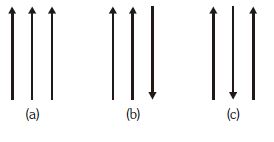
- 2When three electric dipoles are near each other, they each experience the electric field of the other two, and the three dipole system has a certain potential energy. Figure below shows three arrangements $(1)$ , $(2)$ and $(3)$ in which three electric dipoles are side by side. All three dipoles have the same magnitude of electric dipole moment, and the spacings between adjacent dipoles are identical. If $U_1$ , $U_2$ and $U_3$ are potential energies of the arrangements $(1)$ , $(2)$ and $(3)$ respectively thenView Solution
- 3The capacity of a parallel plate condenser is $5\,\mu F$. When a glass plate is placed between the plates of the conductor, its potential becomes $1/8^{th}$ of the original value. The value of dielectric constant will beView Solution
- 4The potential function of an electrostatic field is given by $V = 2x^2$. Determine the electric field strength at the point $(2\,m, 0, 3\,m)$View Solution
- 5Combination of two identical capacitors, a resistor $R$ and a $DC$ voltage source of voltage $6\; V$ is used in an experiment on $C-R$ circuit. It is found that for a parallel combination of the capacitor the time in which the voltage of the fully charged combination reduces to half its original voltage is $10\; s$. For series combination the time needed for reducing the voltage of the fully charged series combination by half isView Solution
- 6Capacitance of a parallel plate capacitor becomes $4/3$ times its original value if a dielectric slab of thickness $t = d/2$ is inserted between the plates ($d$ is the separation between the plates). The dielectric constant of the slab isView Solution
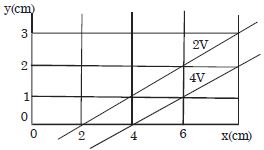
- 7Figure shows two equipotential lines in $x, y$ plane for an electric field. The scales are marked. The $x-$ component $E_x$ and $y$ -component $E_y$ of the electric field in the space between these equipotential lines are respectively :-View Solution
- 8Two particles each of mass $m$ and charge $q$ are separated by distance $r_1$ and the system is left free to move at $t = 0$. At time $t$ both the particles are found to be separated by distance $r_2$. The speed of each particle isView Solution
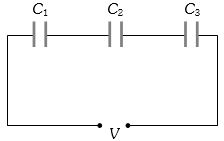
- 9In the figure, three capacitors each of capacitance $6\,pF$ are connected in series. The total capacitance of the combination will beView Solution
- 10Two positive point charges of $12\,\mu C$ and $8\,\mu C$ are $10\,cm$ apart. The work done in bringing them $4\, cm$ closer isView Solution