MCQ
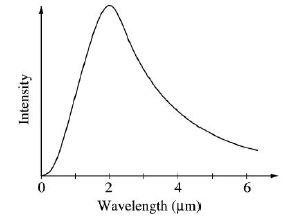
The distribution of relative intensity $I (\lambda)$ of blackbody radiation from a solid  object versus the wavelength $\lambda$ is shown in the figure. If the Wien displacement law  onstant is $2.9 × 10^{-3}\  mK$, what is the approximate temperature of the object ....... $K$
  • A
    $10$
  • B
    $50$
  • C
    $250$
  • $1500$

Answer

Correct option: D.
$1500$
d
${\lambda _m}T$ = constant

Need a full question paper?

Generate a complete, print-ready paper with questions like this in minutes — across 16+ boards, with answer keys.

Start Generating Free

Similar questions

A particle performs uniform circular motion with an angular momentum $L.$  If the angular frequency of the particle is doubled and kinetic energy is halved, its angular momentum becomes
A student says that he had applied a force $\text{F}=-\text{k}\sqrt{\text{x}}$ on a particle and the particle moved in simple harmonic motion. He refuses to tell whether k is a constant or not. Assume that he was worked only with positive x and no other force acted on the particle.
  1. As x increases k increases.
  2. As x increases k decreases.
  3. As x increases k remains constant.
  4. The motion cannot be simple harmonic.
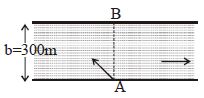
A river is flowing with velocity $5\ km/hr$ as shown in the figure. A boat starts from $A$ and reaches the other bank by covering shortest possible distance . Velocity of boat in still water is $3\ km/ hr$. The distance boat covers is    ......... $m$
A ball of mass $0.5\, kg$ moving with a velocity of $2\, m/sec$ strikes a wall normally and bounces back with the same speed. If the time of contact between the ball and the wall is one millisecond, the average force exerted by the wall on the ball is ......... $N$
If g is the acceleration due to gravity on the earth's surface, the gain in the potential energy of an object of mass m raised from the surface of earth to a height equal to the radius R of the earth is:
Density of rubber is $​d$​. $​ A$​ thick rubber cord of length $​L$​ and cross-section area $​A$​ undergoes elongation under its own weight on suspending it. This elongation is proportional to
A particle of mass $M$ originally at rest is subjected to a force whose direction is constant but magnitude varies with time according to the relation

$F=F_{0}\left(1-\left(\frac{t-T}{T}\right)^{2}\right)$

Where $F_{0}$ and $T$ are constants. The force acts only for the time internal $2 T$. The velocity $v$ of the particle after time $2 {T}$ is -

If the kinetic energy of a body is directly proportional to time $t,$ the magnitude of force acting on the body is

$(i)$ directly proportional to $\sqrt t$
$(ii)$  inversely proportional to  $\sqrt t$
$(iii)$ directly proportional to the speed of the body
$(iv)$ inversely proportional to the speed of body

A string under a tension of $129.6\,\, N$ produces $10\,\, beats /sec$  when it is vibrated along with a tuning fork. When the tension is the string is increased to $160\,\, N,$ it sounds in unison with same tuning fork. calculate fundamental freq. of tuning fork .... $Hz$
A body is moved along a straight line by a machine delivering constant power. The distance moved by the body in time $ t$  is proportional to