Question
The domain of the function $\cos ^{-1}(2 x-1)$ is

Answer

(a) : We know, $0 \leq \cos ^{-1}(2 x-1) \leq \pi$
$\Rightarrow-1 \leq 2 x-1 \leq 1 \Rightarrow 0 \leq 2 x \leq 2 \Rightarrow 0 \leq x \leq 1$
$\therefore$ Domain of $\cos ^{-1}(2 x-1)=[0,1]$

Need a full question paper?

Generate a complete, print-ready paper with questions like this in minutes — across 16+ boards, with answer keys.
Start Generating Free

Similar questions

$\frac{\text{d}^{20}}{\text{dx}^{20}}(2\cos\text{x}\cos3\text{x})=$
  1. $2^{20}(\cos2\text{x}-2^{20}\cos4\text{x})$
  2. $2^{20}(\cos2\text{x}+2^{20}\cos4\text{x})$
  3. $2^{20}(\sin2\text{x}+2^{20}\sin4^\text{x})$
  4. $2^{20}(\sin2\text{x}-2^{20}\sin4^\text{x})$
If P(A) + P(B) = 1; then which of the following option explains the event A and B correctly?
  1. Event A and B are mutually exclusive, exhaustive and complementary events.
  2. Event A and B are mutually exclusive and exhaustive events.
  3. Event A and B are mutually exclusive and complementary events.
  4. Event A and B are exhaustive and complementary events.
If $\alpha=\tan^{-1}\Big(\tan\frac{5\pi}{4}\Big)$ and $\beta=\tan^{-1}\Big(-\tan\frac{2\pi}{3}\Big),$ then:
  1. $4\alpha=3\beta$
  2. $3\alpha=4\beta$
  3. $\alpha-\beta=\frac{7\pi}{12}$
  4. $\text{none of these}$
Choose the correct answer from the given four options.
The locus represented by xy + yz = 0 is:
If A and B are two events such that P(A) = 0.4, P(B) = 0.3 and $\text{P}(\text{A}\cup\text{B})=0.5,$ then $\text{P}(\overline{\text{B}}\cap\text{A})$ equals.
$\int\limits^\frac{\pi}{3}_\frac{\pi}{6}\frac{1}{\sin2\text{x}}\text{ dx}$ is equal to:
  1. $\log_\text{e}{3}$
  2. $\log_\text{e}\sqrt{3}$
  3. $\frac{1}{2}\log(-1)$
  4. $\log(-1)$
The eqution of the plane which cute equal intercepts of unit length on the coordinate axes is:
  1. x + y + z = 1
  2. x + y + z = 0
  3. x + y - z = 1
  4. x + y + z = 2
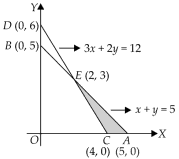
The maximum value of $Z=5 x+3 y$, if the shaded region represents the feasible region, is
Image
If the polynomial equation $\text{a}_0\text{x}^{\text{n}}+\text{a}_{\text{n}-1}\text{x}^{\text{n}-1}+\text{a}_{\text{n}-2}\text{x}^{\text{n}-2}+...\text{a}_2\text{x}^2+\text{a}_1\text{x}+\text{a}_0=0$ n positive integer,has two different real roots $\alpha$ and $\beta,$ then between $\alpha$ and $\beta,$ the equation $\text{n}\text{a}_{\text{n}}\text{x}^{\text{n}-1}+(\text{n}-1)\text{a}_{\text{n}-1}\text{x}^{\text{n}-2}+...+\text{a}_1=0$ has:
  1. Exactly one root.
  2. Almost one root.
  3. At least one root.
  4. No root.
The function $f$ defined by $f(x)=4 x^4-2 x+1$ is increasing for