MCQ
The domain of the function $f(x) = \frac{1}{{{{\log }_{10}}(1 - x)}} + \sqrt {x + 2} $ is
  • A
    $( - 3,\; - 2.5) \cup ( - 2.5,\; - 2)$
  • $( - 2,\;0) \cup (0,\;1)$
  • C
    $(0, 1)$
  • D
    None of these

Answer

Correct option: B.
$( - 2,\;0) \cup (0,\;1)$
b
(b) $x + 2 \ge 0$ $i.e.,$ $x \ge - 2{\rm{ or }} - 2 \le x$

$\because {\log _{10}}(1 - x) \ne 0$==> $1 - x \ne 1$==> $x \ne 0$

Again $1 - x > 0$ ==> $1 > x$ ==> $x < 1$

All these can be combined as $ - 2 \le x < 0$ and $0 < x < 1$.

Need a full question paper?

Generate a complete, print-ready paper with questions like this in minutes — across 16+ boards, with answer keys.
Start Generating Free

Similar questions

A coin is tossed $4$ times. The probability that at least one head turns up is
Three persons work independently on a problem. If the respective probabilities that they will solve it are $\frac{{1}}{{3}} , \frac{{1}}{{4}}$ and $\frac{{1}}{{5}}$, then the probability that none can solve it
The equation of the circle with centre at $(1, -2)$ and passing through the centre of the given circle ${x^2} + {y^2} + 2y - 3 = 0$, is
Coefficient of $x^{64}$ in the expansion of $(x - 1)^2(x - 2)^3(x - 3)^4(x - 4)^5 .... (x - 10)^{11}$ 
Let $\mathrm{A}(\mathrm{a}, 0), \mathrm{B}(\mathrm{b}, 2 \mathrm{~b}+1)$ and $\mathrm{C}(0, \mathrm{~b}), \mathrm{b} \neq 0, \mathrm{|b} \mid \neq 1$ be points such that the area of triangle $\mathrm{ABC}$ is $1 \,\mathrm{sq}$. unit, then the sum of all possible values of a is :
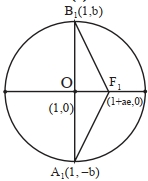
Let an ellipse with centre $(1,0)$ and latus rectum of length $\frac{1}{2}$ have its major axis along $x$-axis. If its minor axis subtends an angle $60^{\circ}$ at the foci, then the square of the sum of the lengths of its minor and major axes is equal to $...........$.
For any natural number $n, 2^{2n} - 1$ is divisible by:
The locus represented by xy + yz = 0 is:
A circle lies in the second quadrant and touches both the axes. If the radius of the circle be $4$, then its equation is
The abscissae of $A$ and $B$ are the roots of the equation ${x^2} + 2ax - {b^2} = 0$ and their ordinates are the roots of the equation ${y^2} + 2py - {q^2} = 0$. The equation of the circle with $AB$ as diameter