MCQ
The domain of the function

$f(x)=\frac{\cos ^{-1}\left(\frac{x^{2}-5 x+6}{x^{2}-9}\right)}{\log _{e}\left(x^{2}-3 x+2\right)} \text { is }$

  • A
    $(-\infty, 1) \cup(2, \infty)$
  • B
    $(2, \infty)$
  • C
    $\left[-\frac{1}{2}, 1\right) \cup(2, \infty)$
  • $\left[-\frac{1}{2}, 1\right) \cup(2, \infty)-\left\{\frac{3+\sqrt{5}}{2}, \frac{3-\sqrt{5}}{2}\right\}$
Answer

Correct option: D.
$\left[-\frac{1}{2}, 1\right) \cup(2, \infty)-\left\{\frac{3+\sqrt{5}}{2}, \frac{3-\sqrt{5}}{2}\right\}$
d
$-1 \leq \frac{x^{2}-5 x+6}{x^{2}-9} \leq 1$

$\frac{x^{2}-5 x+6}{x^{2}-9}-1 \leq 0$

$\frac{1}{x+3} \geq 0$

$x \in(-3, \infty) \ldots \ldots(1)$

$\frac{x^{2}-5 x+6}{x^{2}-9}+1 \geq 0$

$\frac{2 x+1}{x+3} \geq 0$

$x \in(-\infty,-3) \cup\left[-\frac{1}{2}, \infty\right) \ldots \ldots(2)$

after taking intersection

$x \in\left[-\frac{1}{2}, \infty\right)$

$x^{2}-3 x+2>0$

$x \in(-\infty, 1) \cup(2, \infty)$

$x^{2}-3 x+2 \neq 1$

$x \neq \frac{3 \pm \sqrt{5}}{2}$

after taking intersection of each solution

$\left[-\frac{1}{2}, 1\right) \cup(2, \infty)-\left\{\frac{3+\sqrt{5}}{2}, \frac{3-\sqrt{5}}{2}\right\}$

Need a full question paper?

Generate a complete, print-ready paper with questions like this in minutes — across 16+ boards, with answer keys.

Start Generating Free

Similar questions

$\cot ^{-1} \frac{\sqrt{1-x^2}}{x}$ equal to :
If $X$ follows a binomial distribution with parameter $\text{n}=100$ and $\text{p}=\frac{1}{3},$ then $P(X = r)$ is maximum when $r =$
A vector of length $3$  perpendicular to each of the vectors $3\,i + j - 4\,k$ and $6\,i + 5\,j - 2\,k$ is
Let the mean and the standard deviation of the probability distribution

$X$ $\alpha$ $1$ $0$ $-3$
$P(X)$ $\frac{1}{3}$ $K$ $\frac{1}{6}$ $\frac{1}{4}$

be $\mu$ and $\sigma$, respectively. If $\sigma-\mu=2$, then $\sigma+\mu$ is equal to....................

Let $h (x)$ be differentiable for all $x$ and let $f (x) = (kx + e^x) h(x)$ where $k$ is some constant. If $h (0) = 5, h ' (0) = - 2$ and $f ' (0) = 18$ then the value of $k$ is equal to
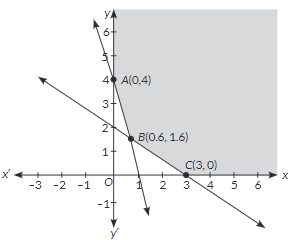
The corner points of the shaded unbounded feasible region of an LPP are $(0,4),(0.6,1.6)$ and $(3,0)$ as shown in the figure. The minimum value of the objective function $Z=4 x+6 y$ occurs at
Image
If $2f(sinx) + f(cos x) = x,$ then $\frac{d}{{dx}}$ $f(x)$ is
Let $x, y, z > 0$ are respectively $2^{nd}, 3^{rd}, 4^{th}$ term of $G.P.$ and $\Delta  = \left| {\begin{array}{*{20}{c}}
{{X^k}}&{{X^{k + 1}}}&{{X^{k + 2}}}\\
{{Y^k}}&{{Y^{k + 1}}}&{{Y^{k + 2}}}\\
{{Z^k}}&{{Z^{k + 1}}}&{{Z^{k + 2}}}
\end{array}} \right| = {\left( {r - 1} \right)^2}\left( {1 - \frac{1}{{{r^2}}}} \right)$ , (where $r$ is common ratio), then $k=$ .......
Let $A = R – \{3\}, B = R – \{1\}.$ Let $f : A \rightarrow B$ be defined by $\text{f(x)}=\frac{\text{x}-2}{\text{x}-3}.$ Then,
The function $\text{f}(\text{x})=\sum_{\text{r}=1}^5(\text{x}-\text{r})^{2}$ assume minimum value at $x =$