MCQ
The Doppler's effect is applicable for
  • A
    Light waves
  • B
    Sound waves
  • C
    Space waves
  • Both $(a)$ and $(b)$

Answer

Correct option: D.
Both $(a)$ and $(b)$
d
(d) Doppler’s effect is applicable for both light and sound waves.

Need a full question paper?

Generate a complete, print-ready paper with questions like this in minutes — across 16+ boards, with answer keys.

Start Generating Free

Similar questions

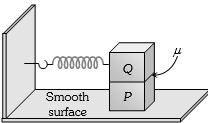
$A$ block $P$ of mass m is placed on a frictionless horizontal surface. Another block Q of same mass is kept on $P$ and connected to the wall with the help of a spring of spring constant k as shown in the figure. ${\mu _s}$ is the coefficient of friction between$  P$ and $ Q$. The blocks move together performing SHM of amplitude $A$. The maximum value of the friction force between $P$ and $Q$ is
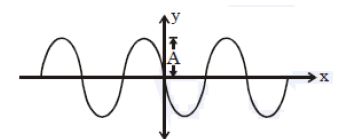
A progressive wave travelling along the positive $x-$ direction is represented by $y(x, t) = A\,sin\,\left( {kx - \omega t + \phi } \right)$. Its snapshot at $t = 0$ is given in the figure For this wave, the phase $\phi $ is
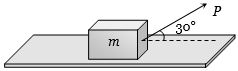
A body of mass m rests on horizontal surface. The coefficient of friction between the body and the surface is $\mu .$ If the mass is pulled by a force $P$ as shown in the figure, the limiting friction between body and surface will be
The couple of tuning forks produces $2$ beats in the time interval of $0.4$ seconds. So the beat frequency is .... $Hz$
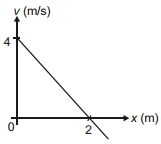
The velocity $(v)$ of a particle moving along $x$-axis varies with its position $x$ as shown in figure. The acceleration $(a)$ of particle varies with position $(x)$ as
A $2100 W$ continuous flow geyser (instant geyser) has water inlet temperature $= 10^o C$ while the water flows out at the rate of $20\,\, g/sec$. The outlet temperature of water must be about ....... $^oC$ 
A liquid cools down from ${70^o}C$ to ${60^o}C$ in $5$ minutes. The time taken to cool it from ${60^o}C$ to ${50^o}C$ will be
The thermal conductivity of a material in $CGS$ system is $0.4$ . In steady state, the rate of flow of heat $10 cal/sec-cm2$ , then the thermal gradient will be ....... $^oC/cm$
Two bodies of mass $3\, kg$ and $4\, kg$ are suspended at the ends of massless string passing over a frictionless pulley. The acceleration of the system is ........ $m/{s^2}$  $(g = 9.8\,m/{s^2})$ 
When we jump out of a boat standing in water it moves