MCQ
The dual nature of light is exhibited by
  • A
    Photoelectric effect
  • B
    Refraction and interference
  • C
    Diffraction and reflection
  • Diffraction and photoelectric effect

Answer

Correct option: D.
Diffraction and photoelectric effect
d
(d)Diffraction shows the wave nature of light and photoelectric effect shows particle nature of light.

Need a full question paper?

Generate a complete, print-ready paper with questions like this in minutes — across 16+ boards, with answer keys.
Start Generating Free

Similar questions

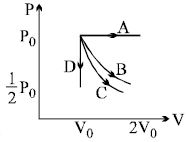
The $PV$ diagram shows four different possible reversible processes performed on a monatomic ideal gas. Process $A$ is isobaric (constant pressure). Process $B$ is isothermal (constant temperature). Process $C$ is adiabatic. Process $D$ is isochoric (constant volume). For which process(es) does the temperature of the gas decrease ?
A medium can carry a longitudinal wave because it has the property of
A fighter jet is flying horizontally at a certain altitude with a speed of $200 \; ms ^{-1}$. When it passes directly overhead an anti-aircraft gun, bullet is fired from the gun, at an angle $\theta$ with the horizontal, to hit the jet. If the bullet speed is $400 \; m / s$, the value of $\theta$ will be $\dots \; {}^o$
After absorbing a slowly moving neutron of mass $m_N$  $(momentum $~ $0)$ a nucleus of mass $M$ breaks into two nuclei of masses $m_1$ and $3m_1$ $(4m_1 = M + m_N)$, respectively. If the de Broglie wavelength of the nucleus with mass $m_1$ is $\lambda$, then de Broglie wavelength of the other nucleus will be
The current in a triode at anode potential $100\,V$ and grid potential $-1.2 \,V is 7.5 \,mA$. If grid potential is changed to $ -2.2\, V$, the current becomes $5.5\, mA$. the value of trans conductance (gm) will be....$mili\, mho$
If a particle moves from point $P (2,3,5)$ to point $Q (3,4,5)$. Its displacement vector be
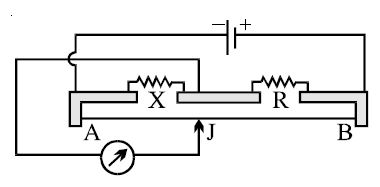
The figure shows a meter-bridge circuit, with $AB = 100\, cm$,$ X = 12\,\Omega$ and $R = 18\,\Omega$ , and the jockey $J$ in the position of balance. If $R$ is now made $8\,\Omega$ , through what distance will $J$ have to be moved to obtain balance? .............. $cm$
A convex lens produces a real image m times the size of the object. What will be the distance of the object from the lens
$\left(P+\frac{a}{V^2}\right)(V-b)=R T$ represents the equation of state of some gases. Where $P$ is the pressure, $V$ is the volume, $T$ is the temperature and $a, b, R$ are the constants. The physical quantity, which has dimensional formula as that of $\frac{b^2}{a}$, will be
Two capacitors of equal capacity are first connected in parallel and then in series. The ratio of the total capacities in the two cases will be