MCQ
The dual nature of light is exhibited by
  • A
    Photoelectric effect
  • B
    Refraction and interference
  • C
    Diffraction and reflection
  • Diffraction and photoelectric effect

Answer

Correct option: D.
Diffraction and photoelectric effect
d
(d)Diffraction shows the wave nature of light and photoelectric effect shows particle nature of light.

Need a full question paper?

Generate a complete, print-ready paper with questions like this in minutes — across 16+ boards, with answer keys.
Start Generating Free

Similar questions

The phenomenon of radioactivity is
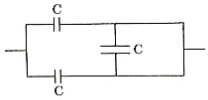
The equivalent capacitance of the combination shown in the figure is :
In a $YDSE$, the central bright fringe can be identified :
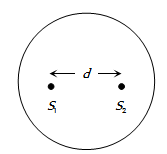
Two coherent sources separated by distance d are radiating in phase having wavelength l. A detector moves in a big circle around the two sources in the plane of the two sources. The angular position of n = 4 interference maxima is given as
Two circular coils $1$ and $2$ are made from the same wire but the radius of the $1^{st}$ coil is twice that of the $2^{nd}$ coil. What is the ratio of potential difference in volts should be applied across them so that the magnetic field at their centres is the same?
$X-$ rays and gamma rays are both electromagnetic waves. Which of the following statements is true
A $p-n$ photodiode is fabricated from a semiconductor with a band gap of $2.5\,\, eV.$ It can detect a signal of wavelength
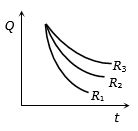
Three identical capacitors are given a charge $Q$ each and they are then allowed to discharge through resistance $R_1, R_2\,$ and $\,R_3$. Their charges, as a function of time shown in the graph below. The smallest of the three resistance is
If a source of power $4\ kW$ produces $10^{20}$ photons/second , the radiation belongs to a part of the spectrum called
Hydrogen $(_1H^1),$ Deuterium $(_1H^2)$,singly ionised Helium $(_2He^4)^+$ and doubly ionised lithium ${\left( {{}_3^6Li} \right)^{ + + }}$, all have one electron around the nucleus. Consider an electron transition from $n = 2$ to $n = 1$. If the wavelengths of emitted radiation are $λ_1,λ_2,λ_3$ and $λ_4$ respectively then approximately which one of the following is correct?