Question
The earth’s surface has a negative surface charge density of 10-9 Cm-2. The potential difference of 400 kV between the top of the atmosphere and the surface results (due to the low conductivity of the lower atmosphere) in a current of only 1800 A over the entire globe. If there were no mechanism of sustaining atmospheric electric field, how much time (roughly) would be required to neutralise the earth’s surface? (This never happens in practice because there is a mechanism to replenish electric charges, namely the continual thunderstorms and lightning in different parts of the globe). (Radius of earth = 6.37 × 106 m.)
Answer

Surface charge density of the earth, $\sigma=10^{-9}\ \text{C m}^{-2}$
Current over the entire globe, $\text{I}=1800\ \text{A}$
Radius of the earth, $\text{r}=6.37\times10^6\ \text{m}$
Surface area of the earth,
$\text{A}=4\pi\text{r}^2$
$=4\pi\times(6.37\times10^6)^2$
$=5.09\times10^{14}\ \text{m}^2$
Charge on the earth surface,
$\text{q}=\sigma\times\text{A}$
$=10^{-9}\times5.09\times10^{14}$
$=5.09\times10^{5}\ \text{C}$
Time taken to neutralize the earth's surface = t
$\text{Current},\ \text{I}=\frac{\text{q}}{\text{t}}$
$\text{t}=\frac{\text{q}}{\text{I}}$
$=\frac{5.09\times10^5}{1800}=282.77\text{s}$
Therefore, the time taken to neutralize the earth's surface is 282.77s.

Need a full question paper?

Generate a complete, print-ready paper with questions like this in minutes — across 16+ boards, with answer keys.

Start Generating Free

Similar questions

The spectrum of a star in the visible and the ultraviolet region was observed and the wavelength of some of the lines that could be identified were found to be:
$824\mathring{\text{A}},970\mathring{\text{A}},1120\mathring{\text{A}},2504\mathring{\text{A}},5173\mathring{\text{A}},6100\mathring{\text{A}}$
Which of these lines cannot belong to hydrogen atom spectrum? (Given Rydberg constant $\text{R}=1.03\times10^7\text{m}^{-1}$ and $\frac{1}{\text{R}}=970\mathring{\text{A}}$ Support your answer with suitable calculations.
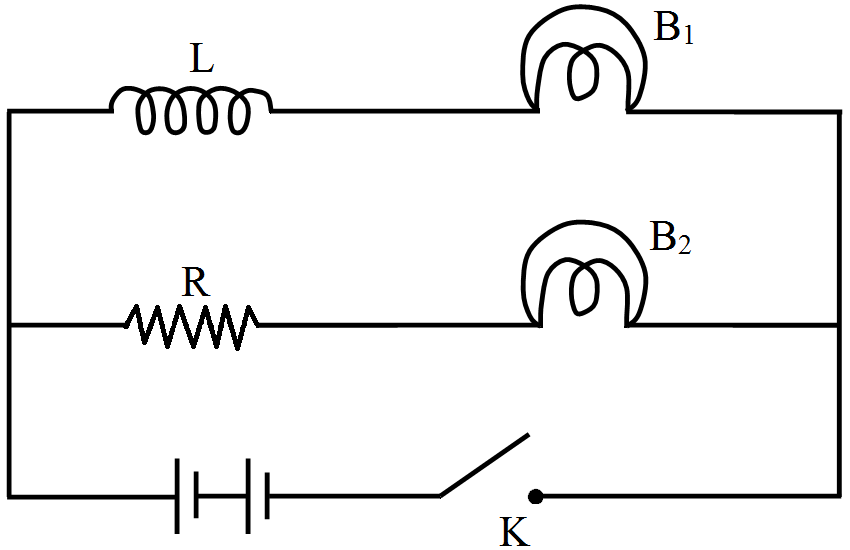
In the given circuit, the value of resistance effect of the coil L is exactly equal to the resistance R. Bulbs B1 and B2 are exactly identical.

Answer the following questions based on above information:

  1. Which one of the two bulbs lights up earlier, when key K is closed and why?
  2. What will be the comparative brightness of the two bulbs after sometime if the key K is kept closed and why?
A point object is placed on the principal axis of a convex lens (f = 15cm) at a distance of 30cm from it. A glass plate $(\mu=1.50)$ of thickness 1cm is placed on the other side of the lens perpendicular to the axis. Locate the image of the point object.
The specification on a heater coil is 250V, 500W. Calculate the resistance of the coil. What will be the resistance of a coil of 1000W to operate at the same voltage?
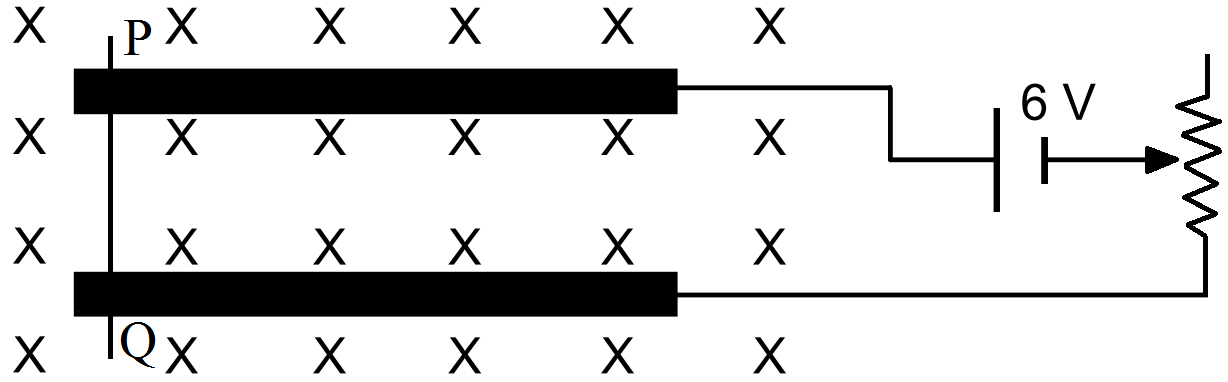
A metal wire PQ of mass 10g lies at rest on two horizontal metal rails separated by 4.90cm A vertically-downward magnetic field of magnitude 0.800T exists in the space. The resistance of the circuit is slowly decreased and it is found that when the resistance goes below 20.0Ω, the wire PQ starts sliding on the rails. Find the coefficient of friction.

Answer the following:
  1. Name the em waves which are suitable for radar systems used in aircraft navigation- Write the range of frequency of these waves.
  2. If the earth did not have atmosphere, would its average surface temperature be higher or lower than what it is now? Explain.
  3. An em wave exerts pressure on the surface on which it is incident. Justify.
Suppose the bob of the previous problem has a speed of 1.4m/ s when the string makes an angle of 0.20 radian with the vertical. Find the tension at this instant. You can use $\cos\theta\approx1-\frac{\theta^2}{2}$ and $\sin\theta\approx\theta$ for small $\theta.$
Explain two  main important points for astronomical telescope.
Find the electric field intensity due to a uniformly charged spherical shell at a point (i) outside the shell and (ii) inside the shell. Plot the graph of electric field with distance from the centre of the shell.
Find the magnetic field B due to a semicircular wire of radius 10.0cm carrying a current of 5.0A at its centre of curvature.