MCQ
The effect caused by lanthanoid contraction is :
  • A
    Same oxidation state of Zr and Nb .
  • Zr and Hf have almost same atomic size.
  • C
    Zr and Y have almst same atomic size.
  • D
    Same oxidation state of Zr and Zn .

Answer

Correct option: B.
Zr and Hf have almost same atomic size.
b

Need a full question paper?

Generate a complete, print-ready paper with questions like this in minutes — across 16+ boards, with answer keys.

Start Generating Free

Similar questions

The ionizable valency of Ni in Ni(CO)4​ is __________.
Iron sheets are galvanized by depositing a coating of or In galvanisation, iron surface is coated with
The magnetic moment of a metal ion of first transition series is $2.83 $ $BM$. Therefore it will have unpaired electrons
Compound $‘A$’ reacts with $PC{l_5}$ to give ‘$B$ ’ which on treatment with $KCN$ followed by hydrolysis gave propanoic acid as the product. What is ‘$A$
Chemical reactions involve interaction of atoms and molecules. A large number of atoms/molecules (approximately $6.023 \times 10^{23}$ ) are present in a few grams of any chemical compound varying with their atomic/molecular masses. To handle such large numbers conveniently, the mole concept was introduced. This concept has implications in diverse areas such as analytical chemistry, biochemistry, electrochemistry and radiochemistry. The following example illustrates a typical case, involving chemical/electrochemical reaction, which requires a clear understanding of the mole concept.

A $4.0$ molar aqueous solution of $\mathrm{NaCl}$ is prepared and $500 \mathrm{~mL}$ of this solution is electrolysed. This leads to the evolution of chlorine gas at one of the electrodes (atomic mass: $\mathrm{Na}=23, \mathrm{Hg}=200 ; 1$ Faraday $=96500$ coulombs)

$1.$ The total number of moles of chlorine gas evolved is

$(A)$ $0.5$  $(B)$ $1.0$  $(C)$ $2.0$  $(D)$ $3.0$

$2.$  If the cathode is a $\mathrm{Hg}$ electrode, the maximum weight ( $\mathrm{g}$ ) of amalgam formed from this solution is

$(A)$ $200$  $(B)$ $225$  $(C)$ $400$  $(D)$ $446$

$3.$ The total charge (coulombs) required for complete electrolysis is

$(A)$ $24125$  $(B)$ $48250$  $(C)$ $96500$  $(D)$ $193000$

Give the answer question $1,2$ and $3.$

Which of the reagent is used to convert $2$ -Butanone into propanoic acid :-
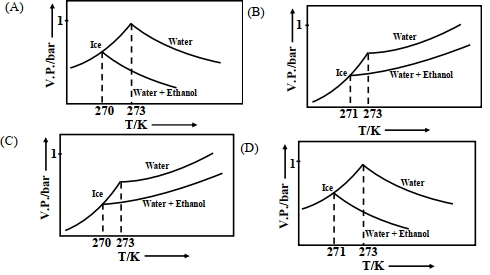
Pure water freezes at $273 \mathrm{~K}$ and $1$ bar. The addition of $34.5 \mathrm{~g}$ of ethanol to $500 \mathrm{~g}$ of water changes the freezing point of the solution. Use the freezing point depression constant of water as $2 \mathrm{~K} \mathrm{~kg} \mathrm{~mol}^{-1}$. The figures shown below represent plots of vapour pressure ($V.P$.) versus temperature ($T$). [molecular weight of ethanol is $46 \mathrm{~g} \mathrm{~mol}^{-1}$ ]

Among the following, the option representing change the freezing point is

(IMAGE)
The vapour pressures of pure liquids $A$ and $B$ are $400$ and $600\, mm\, Hg$, respectively at $298\, K$. On mixing the two liquids, the sum of their initial volumes is equal to the volume of the final mixture. The mole fraction of liquid $B$ is $0.5$ in the mixture. The vapour pressure of the final solution, the mole fractions of components $A$ and $B$ in vapour phase, respectively are
Benzoic acid reacts with $SOCl_2$ to give :-
Which of the following is used in the manufacture of thermosetting plastics