MCQ
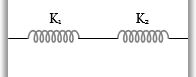
The effective spring constant of two spring system as shown in figure will be
- ✓${K_1} + {K_2}$
- B${K_1}{K_2}/{K_1} + {K_2}$
- C${K_1} - {K_2}$
- D${K_1}{K_2}/{K_1} - {K_2}$
i.e. $F = {F_1} + {F_2}$
==> $ - \,kx = - \,{k_1}x - {k_2}x$
$\Rightarrow $$k = {k_1} + {k_2}$
Generate a complete, print-ready paper with questions like this in minutes — across 16+ boards, with answer keys.
Statement$- I$ : Susceptibilities of paramagnetic and ferromagnetic substances increase with decrease in temperature.
Statement$- II$: Diamagnetism is a result of orbital motions of electrons developing magnetic moments opposite to the applied magnetic field. Choose the $CORRECT$ answer from the options given below : -
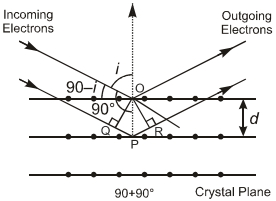
Electrons accelerated by potential $V$ are diffracted from a crystal. If $d =1\; \mathring A$, and $i =30^{\circ}$. $V$ should be about ....... $V$
$\left( h =6.6 \times 10^{-34}\; J-s , m =9.1\times 10^{-31}\; kg , e =1.610^{-19} \;C \right)$