MCQ
The efficiency of a Carnot engine depends upon
  • A
    the temperature of the source only
  • B
    the temperature of the sink only
  • the temperatures of the source and sink
  • D
    the volume of the cylinder of the engine

Answer

Correct option: C.
the temperatures of the source and sink
c
Efficiency of Carnot engine

$\eta=\left(1-\frac{T_{2}}{T_{1}}\right) \times 100 \%$

So efficiency depends on temperature of source $\left(T_{1}\right)$ and temperature of $\sin k\left(T_{2}\right)$

Need a full question paper?

Generate a complete, print-ready paper with questions like this in minutes — across 16+ boards, with answer keys.
Start Generating Free

Similar questions

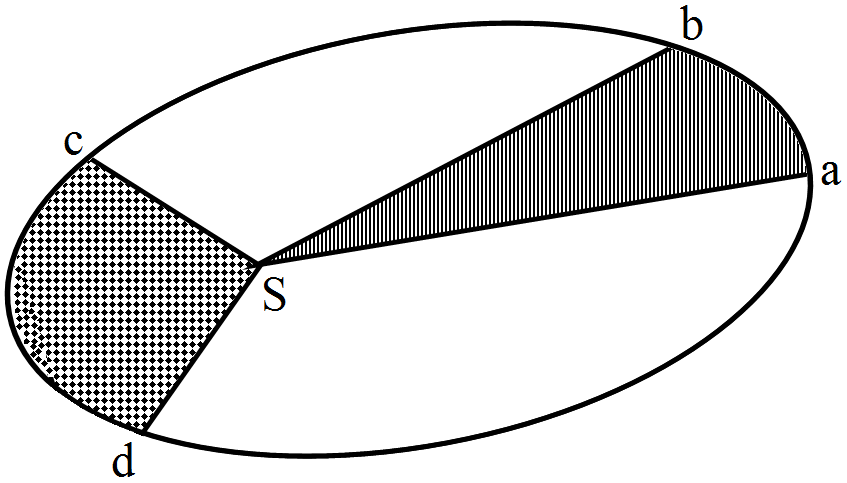
Shows the elliptical path of a planet about the sun. The two shaded parts have equal area. If t1 and t2 be the time taken by the planet to go from a to b and from c to d respectively:

  1. t1 < t2
  2. t1 = t2
  3. t1 > t2
  4. Insufficient information to deduce the relation between t1 and t2.
The waves in which the particles of the medium vibrate in a direction perpendicular to the direction of wave motion is known as
A semiconducting device is connected in a series circuit with a battery and a resistance. A current is found to pass through the circuit. If the polarity of the battery is reversed, the current drops to almost zero. the device may be:
  1. An intrinsic semiconductor.
  2. A p-type semiconductor.
  3. An n-type semiconductor.
  4. A p-n junction.
A vector $\overrightarrow{\text{A}}$ points vertically upward and $\overrightarrow{\text{B}}$ points towards north. The vector product $\overrightarrow{\text{A}}\times\overrightarrow{\text{B}}$ is:
  1. Along west.
  2. Along east.
  3. Zero.
  4. Vertically downward.
The absolute temperatures of two black bodies are $2000 K$ and $3000 K$ respectively. The ratio of wavelengths corresponding to maximum emission of radiation by them will be
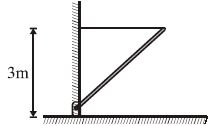
A uniform rod of mass $15\,kg$ and length $5\,m$ is held stationary with the help of a light string as shown. Then tension in the string is ......... $N.$
Four particles given, have same momentum which has maximum kinetic energy
What is the angle between $\overrightarrow P $ and the resultant of $(\overrightarrow P + \overrightarrow Q )$ and $(\overrightarrow P - \overrightarrow Q )$
An insect is crawling up on the concave surface of a fixed hemispherical bowl of radius R. If the coefficient of friction is $\frac13$ then the height up to which the insect can crawl is nearly:
$A$ projectile of mass $"m"$ is projected from ground with a speed of $50 \,m/s$ at an angle of $53^o$ with the horizontal. It breaks up into two equal parts at the highest point of the trajectory. One particle coming to rest immediately after the explosion. The ratio of the radii of curvatures of the moving particle just before and just after the explosion are: