MCQ
The electric current in a chemical cell is due to movement of:
  • A
    Positive hole charges.
  • B
    Positive ions only.
  • C
    Negative ions only.
  • Positive and negative ions.

Answer

Correct option: D.
Positive and negative ions.
An electrolyte solution is formed by mixing an electrolyte in a solvent. The electrolyte on dissolution furnishes ions. The preferred movement of ions under the influence of the electric field is responsible for electric current. Hence, the electric current in a chemical cell is due to the movement of positive and negative ions.

Need a full question paper?

Generate a complete, print-ready paper with questions like this in minutes — across 16+ boards, with answer keys.
Start Generating Free

Similar questions

Select the appropriate option for the given statement. Sodium salts of some acids are very useful as $.......$
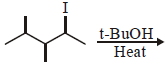
The major product in the following reaction is 
Total number of essential amino acid among the given list of amino acids is . . . . 

Arginine, Phenylalanine, Aspartic acid, Cysteine, Histidine, Valine, Proline

The addition of a catalyst during a chemical reaction alters which of the following quantities?
Choose the correct Statements from the following:

$(A)$ Ethane-$1\ 2$-diamine is a chelating ligand.

$(B)$ Metallic aluminium is produced by elecrtrolysis of aluminium oxide in presence of cryolite.

$(C)$ Cyanide ion is used as ligand for leaching of silver.

$(D)$ Phosphine act as a ligand in Wilkinson catalyst.

$(E)$ The stability constants of $\mathrm{Ca}^{2+}$ and $\mathrm{Mg}^{2+}$ are similar with $EDTA$ complexes.

Choose the correct answer from the options given below:

Bleaching action of $S{O_2}$ is due to
In the following sequence of the reations, what is $D$?

(image) $\xrightarrow{{[O]}}A\xrightarrow{{SOC{l_2}}}B\xrightarrow{{Na{N_3}}}C\xrightarrow{{Heat}}D$

Write the $\text{IUPAC}$ name of the given compound:$\text{HO}−\text{CH}_2​−\text{​CH}−\text{CH}_2​−\text{OH}​\\ \ \ \ \ \ \ \ \ \ \ \ \ \ \ \ \ \ \ \ \ \ \ ∣ \\ \ \ \ \ \ \ \ \ \ \ \ \ \ \ \ \ \ \ \ \ \text{CH}_3​​$
$1^o$ amine and $2^o$ Amine can be differentiated by
Select the $INCORRECT$ statement regarding following reaction is :

$Xe{F_6}\,\xrightarrow{{excess\,\,{H_2}O}}\,'X'\, + \,HF$

$Xe{F_6}\,\xrightarrow{{2\,moles\,{H_2}O}}\,'Y'\, + \,HF$