Question
The electric field near a conducting surface having a uniform surface charge density σ is given by
|
(a) |
(b) |
|
(c) |
(d) |
The electric field near a conducting surface having a uniform surface charge density σ is given by
|
(a) |
(b) |
|
(c) |
(d) |
(c)  and is normal to the surface
Generate a complete, print-ready paper with questions like this in minutes — across 16+ boards, with answer keys.
The electrochemical equivalent of magnesium is 0.126 mg/C. A current of 5 A is passed in a suitable solution for 1 hour. The mass of magnesium deposited will be
|
(a) 0.0378 gm |
(b) 0.227 gm |
(c) 0.378 gm |
(d) 2.27 gm |
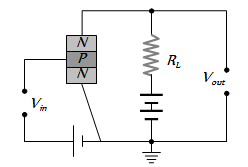
An NPN-transistor circuit is arranged as shown in figure. It is
|
(a) A common base amplifier circuit |
(b) A common emitter amplifier circuit |
|
(c) A common collector amplifier circuit |
(d) Neither of the above |
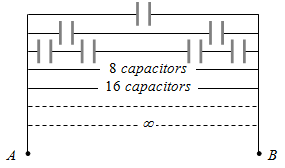
An infinite number of identical capacitors each of capacitance 1 μF are connected as in adjoining figure. Then the equivalent capacitance between A and B is
|
(a) 1 μF |
(b) 2 μF |
(c) |
(d) ∞ |
A convex lens is used to form real image of an object on a screen. It is observed that even when the positions of the object and that screen are fixed there are two positions of the lens to form real images. If the heights of the images are 4 cm and 9 cm respectively, the height of the object is
|
(a) 2.25 cm |
(b) 6.00 cm |
(c) 6.50 cm |
(d) 36.00 cm |
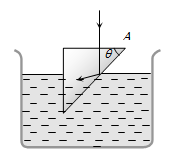
The refractive index of the material of the prism and liquid are 1.56 and 1.32 respectively. What will be the value of q for the following refraction
|
(a) sinθ ≥ |
(b) sinθ ≥ |
(c) sinθ ≥ |
(d) sinθ ≥ |
When light of wavelength 300 nm (nanometer) falls on a photoelectric emitter, photoelectrons are liberated. For another emitter, however light of 600 nm wavelength is sufficient for creating photoemission. What is the ratio of the work functions of the two emitters
|
(a) 1 : 2 |
(b) 2 : 1 |
(c) 4 : 1 |
(d) 1 : 4 |


