MCQ
The electric field of a plane electromagnetic wave is given by

$\overrightarrow{\mathrm{E}}=\mathrm{E}_{0} \frac{\hat{\mathrm{i}}+\hat{\mathrm{j}}}{\sqrt{2}} \cos (\mathrm{kz}+\omega \mathrm{t})$ At $\mathrm{t}=0,$ a positively charged particle is at the point $(\mathrm{x}, \mathrm{y}, \mathrm{z})=\left(0,0, \frac{\pi}{\mathrm{k}}\right) .$ If its instantaneous velocity at $(t=0)$ is $v_{0} \hat{\mathrm{k}},$ the force acting on it due to the wave is

  • A
    $0$
  • B
    parallel to $\frac{\mathrm{i}+\mathrm{j}}{\sqrt{2}}$
  • antiparallel to $\frac{\hat{\mathrm{i}}+\hat{\mathrm{j}}}{\sqrt{2}}$
  • D
    parallel to $\hat{\mathrm{k}}$

Answer

Correct option: C.
antiparallel to $\frac{\hat{\mathrm{i}}+\hat{\mathrm{j}}}{\sqrt{2}}$
c
$\overrightarrow{\mathrm{F}}=\mathrm{q}(\overrightarrow{\mathrm{E}}+\overrightarrow{\mathrm{v}} \times \overrightarrow{\mathrm{B}})$

$\overrightarrow{\mathrm{E}}=\mathrm{E}_{0}\left(\frac{\hat{\mathrm{i}}+\hat{\mathrm{j}}}{\sqrt{2}}\right) \cos \pi$

$=-\mathrm{E}_{0} \frac{\hat{\mathrm{i}}+\hat{\mathrm{j}}}{\sqrt{2}}$

as $\quad \overrightarrow{E} \times \overrightarrow{B}=\overrightarrow{\mathrm{c}}$

$+\mathrm{E}_{0}\left(\frac{\hat{\mathrm{i}}+\hat{\mathrm{j}}}{\sqrt{2}}\right) \times \overrightarrow{\mathrm{B}}=\mathrm{c} \hat{\mathrm{k}}$

$\Rightarrow \overrightarrow{\mathrm{B}}=-\left(\frac{\hat{\mathrm{i}}-\hat{\mathrm{j}}}{\sqrt{2}}\right) \frac{\mathrm{E}_{0}}{\mathrm{c}}$

$\overline{\mathrm{F}}=\mathrm{q}\left(-\mathrm{E}_{0} \frac{(\hat{\mathrm{i}}+\hat{\mathrm{j}})}{\sqrt{2}}-\frac{\mathrm{v}_{0} \hat{\mathrm{k}}}{\mathrm{c}} \times(\hat{\mathrm{i}}-\hat{\mathrm{j}}) \mathrm{E}_{\mathrm{o}}\right)$

since $\frac{v_{0}}{c}<<1$

$\Rightarrow \mathrm{F}$ is antiparallel to $\frac{\mathrm{i}+\mathrm{j}}{\sqrt{2}}$

Need a full question paper?

Generate a complete, print-ready paper with questions like this in minutes — across 16+ boards, with answer keys.

Start Generating Free

Similar questions

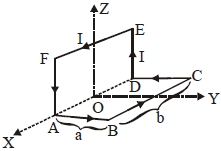
A wire carrying current $I$ is bent in the shape $A\,B\,C\,D\,E\,F\,A$ as shown, where rectangle $A\,B\,C\,D\,A$ and $A\,D\,E\,F\,A$ are perpendicular to each other. If the sides of the rectangles are of lengths $a$ and $b,$ then the magnitude and direction of magnetic moment of the loop $A\,B\,C\,D\,E\,F\,A\,$ is
If you are provided three resistances $2  \,\Omega$, $3  \,\Omega$ and $6 \,\Omega$. How will you connect them so as to obtain the equivalent resistance of $4  \,\Omega$
A circular coil ‘A’ has a radius R and the current flowing through it is I. Another circular coil ‘B’ has a radius 2R and if 2I is the current flowing through it, then the magnetic fields at the centre of the circular coil are in the ratio of (i.e. $B_A$ to $B_B$ )
Domain formation is the necessary feature of:
An electric charge q is placed at the centre of a cube of side α. The electric flux on one of its faces will be
Through which mode of propagation, the radio waves can be sent from one place to another
A capacitor with air as the dielectric is charged to a potential of $100\;volts$. If the space between the plates is now filled with a dielectric of dielectric constant $10$, the potential difference between the plates will be......$volts$
The charge on 500 cc of water due to protons will be
A lamp whose resistance is $280 \Omega$ is joined with an ac source of 200 V . The peak value of current flowing in the lamp is :
A dielectric slab is inserted between the plates of an isolated capacitor. The force between the plates will: