MCQ
The electric fields of two plane electromagnetic plane waves in vacuum are given by

$\overrightarrow{\mathrm{E}}_{1}=\mathrm{E}_{0} \hat{\mathrm{j}} \cos (\omega \mathrm{t}-\mathrm{kx})$ and

$\overrightarrow{\mathrm{E}}_{2}=\mathrm{E}_{0} \hat{\mathrm{k}} \cos (\omega \mathrm{t}-\mathrm{ky})$

At $t=0,$ a particle of charge $q$ is at origin with a velocity $\overrightarrow{\mathrm{v}}=0.8 \mathrm{c} \hat{\mathrm{j}}$ ($c$ is the speed of light in vacuum). The instantaneous force experienced by the particle is 

  • A
    $\mathrm{E}_{0} \mathrm{q}(-0.8 \hat{\mathrm{i}}+\hat{\mathrm{j}}+\hat{\mathrm{k}})$
  • B
    $\mathrm{E}_{0} \mathrm{q}(0.8 \hat{\mathrm{i}}-\hat{\mathrm{j}}+0.4 \hat{\mathrm{k}})$
  • $\mathrm{E}_{0} \mathrm{q}(0.8 \hat{\mathrm{i}}+\hat{\mathrm{j}}+0.2 \hat{\mathrm{k}})$
  • D
    $\mathrm{E}_{0} \mathrm{q}(0.4 \hat{\mathrm{i}}-3 \hat{\mathrm{j}}+0.8 \hat{\mathrm{k}})$
Answer

Correct option: C.
$\mathrm{E}_{0} \mathrm{q}(0.8 \hat{\mathrm{i}}+\hat{\mathrm{j}}+0.2 \hat{\mathrm{k}})$
c
$\overrightarrow{\mathrm{E}}_{1}=\mathrm{E}_{0} \mathrm{j} \cos (\omega \mathrm{t}-\mathrm{kx})$

Its corresponding magnetic field will be

$\overrightarrow{\mathrm{B}}_{1}=\frac{\mathrm{E}_{0}}{\mathrm{c}} \hat{\mathrm{k}} \cos (\omega \mathrm{t}-\mathrm{kx})$

$\overrightarrow{\mathrm{E}}_{2}=\mathrm{E}_{0} \hat{\mathrm{k}} \cos (\omega \mathrm{t}-\mathrm{ky})$

$\overrightarrow{\mathrm{B}}_{2}=\frac{\mathrm{E}_{0}}{\mathrm{c}} \hat{\mathrm{i}} \cos (\omega \mathrm{t}-\mathrm{ky})$

Net force on charge particle

$=\mathrm{q} \overrightarrow{\mathrm{E}}_{1}+\mathrm{q} \overrightarrow{\mathrm{E}}_{2}+\mathrm{q} \overrightarrow{\mathrm{v}} \times \mathrm{B}_{1}+\mathrm{q} \overrightarrow{\mathrm{v}} \times \overrightarrow{\mathrm{B}}_{2}$

$=\mathrm{q} \mathrm{E}_{0} \hat{\mathrm{j}}+\mathrm{q} \mathrm{E}_{0} \hat{\mathrm{k}}+\mathrm{q}(0.8 \mathrm{c} \hat{\mathrm{j}}) \times\left(\frac{\mathrm{E}_{0}}{\mathrm{c}} \hat{\mathrm{k}}\right)+\mathrm{q}(0.8 \mathrm{c} \hat{\mathrm{j}}) \times\left(\frac{\mathrm{E}_{0}}{\mathrm{c}} \hat{\mathrm{i}}\right)$

$=\mathrm{q} \mathrm{E}_{0} \hat{\mathrm{j}}+\mathrm{q} \mathrm{E}_{0} \hat{\mathrm{k}}+0.8 \mathrm{q} \mathrm{E}_{0} \hat{\mathrm{i}}-0.8 \mathrm{q} \mathrm{E}_{0} \hat{\mathrm{k}}$

$\overrightarrow{\mathrm{F}}=\mathrm{q} \mathrm{E}_{0}[0.8 \hat{\mathrm{i}}+1 \hat{\mathrm{j}}+0.2 \hat{\mathrm{k}}]$

Need a full question paper?

Generate a complete, print-ready paper with questions like this in minutes — across 16+ boards, with answer keys.

Start Generating Free

Similar questions

When a diode is forward biased, it has a voltage drop of $0.5\, V.$ The safe limit of current through the diode is $10\, mA$. If a battery of emf $1.5\, V$ is used in the circuit, the value of minimum resistance to be connected in series with the diode so that the current does not exceed the safe limit is$.....\Omega$
You stand on a spring scale on the floor of an elevator. Of the following, the scale shows  the highest reading when the elevator
The work done in rotating a bar magnet of magnetic moment $M$ from its unstable equilibrium position to its stable equilibrium position in a uniform magnetic field $B$ is .........
One-forth length of a spring of force constant $K$ is cut away. The force constant of the remaining spring will be
The $ P.E.$ of a particle executing $SHM$ at a distance $x$ from its equilibrium position is
The length of a cylinder is measured with a metre rod having least count $0.1 \;cm$. Its diameter is measured with vernier calipers having least count $0.01\; cm$. If the length and diameter of the cylinder are $5.0\; cm$ and $2.00\; cm$, respectively, then the percentage error in the calculated value of volume will be
In the Young's double slit experiment, the intensity of light at a point on the screen where the path difference $\lambda$ is $K,$ ($\lambda$ being the wavelength of light used). The intensity at a point where the path difference is $\lambda /4$ will be
Given below are two statements. One is labelled as Assertion (A) and the other is labelled as Reason (R).
Assertion (A) : The binding energy per nucleon is found to be practically independent of the atomic number A , for nuclei with mass numbers between 30 and 170.
Reason (R): Nuclear force is long range.
In the light of the above statements, choose the correct answer from the options given below :
The acceleration due to gravity at a height $1\, km$ above the earth is the same as at a depth $d$ below the surface of earth. Then  $d\,=$ ......... $km$
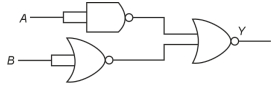
The output ( $Y$ ) of the given logic gate is similar to the output of an/a