The electric potential at a distance of $3 \,m$ on the axis of a short dipole of dipole moment $4 \times 10^{-12}$ coulomb-meter is ......... $mV$
Easy


Download our appand get started for free
Experience the future of education. Simply download our apps or reach out to us for more information. Let's shape the future of learning together!No signup needed.*
Similar Questions
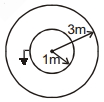
- 1Figure shows a solid conducting sphere of radius $1 m$, enclosed by a metallic shell of radius $3 \,m$ such that their centres coincide. If outer shell is given a charge of $6 \,\mu C$ and inner sphere is earthed, find magnitude charge on the surface of inner shell is ............. $\mu C$View Solution
- 2When a positive $q$ charge is taken from lower potential to a higher potential point, then its potential energy willView Solution
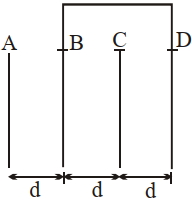
- 3Four identical rectangular plates with length, $l=2\, cm$ and breadth, $b =\frac{3}{2}\, cm$ are arranged as shown in figure. The equivalent capacitance between $A$ and $C$ is $\frac{ x \varepsilon_{0}}{ d } .$ The value of $x$ is (Round off to the Nearest Integer)View Solution
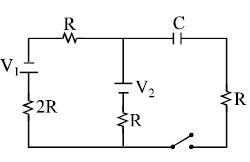
- 4View SolutionIn the transient current circuit shown, the time constant is
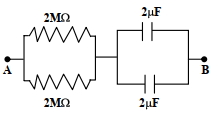
- 5At time $\mathrm{t}=0$, a battery of $10 \mathrm{~V}$ is connected across points $\mathrm{A}$ and $\mathrm{B}$ in the given circuit. If the capacitors have no charge initially, at what time (in seconds) does the voltage across them becomes $4$ volt?View Solution
[take $\ln 5=1.6, \ln 3=1.1]$
- 6A spherical condenser has inner and outer spheres of radii $a$ and $b$ respectively. The space between the two is filled with air. The difference between the capacities of two condensers formed when outer sphere is earthed and when inner sphere is earthed will beView Solution
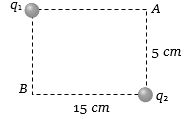
- 7$n$ the rectangle, shown below, the two corners have charges ${q_1} = - 5\,\mu C$ and ${q_2} = + 2.0\,\mu C$. The work done in moving a charge $ + 3.0\,\mu C$ from $B$ to $A$ is.........$J$ $(1/4\pi {\varepsilon _0} = {10^{10}}\,N{\rm{ - }}{m^2}/{C^2})$View Solution
- 8A $10\,\mu F$ capacitor is charged to a potential difference of $1000\, V$. The terminals of the charged capacitor are disconnected from the power supply and connected to the terminals of an uncharged $6\, \mu F$ capacitor. What is the final potential difference across each capacitor?......$V$View Solution
- 9What is the potential energy of the equal positive point charges of $1\,\mu C$ each held $1\, m$ apart in airView Solution
- 10A capacitor is connected to a $10\,V$ battery. The charge on the plates is $10\,\mu C$ when medium between plates is air. The charge on the plates become $100\,\mu C$ when space between plates is filled with oil. The dielectric constant of oil isView Solution