Question
The electrochemical cell shown below is concentration cell. M|M2+ (saturated solution of a sparingly soluble salt, MX2) || M2+ (0.001 mol dm-3) |M The emfof the cell depends on the difference in concentrations of M2+ ions at the two electrodes. The emf of the cell at 298 K is 0.059V. The following questions are multiple choice questions. Choose the most appropriate answer:
- The solubility product (Ksp' mol3 dm-9) of MX2 at 298 K based on the information available for the given concentration cell is $(\text{take }2.303 \times \text{R}\times \frac{298}{\text{F}} = 0.059)$
- 2 × 10-15
- 4 × 10-15
- 3 × 10-12
- 1 × 10-12
- The value of $\triangle\text{G}$ (in kJ mol-1) for the given cell is (take 1 F = 96500 C mol-1)
- 3.7
- -3.7
- 10.5
- -11.4
- The equilibrium constant for the foUowing reaction is:
$\text{Fe}^{2+}+\text{Ce}^{4+}\rightleftharpoons\text{Ce}^{3+}+\text{Fe}^{3+}$
(Given, $\text{E}^\circ_\frac{\text{Ce}^{4+}}{\text{Ce}^{3+}}=1.44\text{V}$ and $\text{E}^\circ_\frac{\text{Fe}^{3+}}{\text{Fe}^{2+}}=0.68\text{V}$)
- 7.6 × 10¹²
- 6.5 × 10¹⁰
- 5.2 × 10⁹
- 3.4 × 10¹²
- The solubility product of a saturated solution of Ag2CrO4 in water at 298 K if the emf of the cell
Ag|Ag+ (satd. Ag2CrO4 soln) || Ag+ (0.1 M) | Ag
is 0.164V at 298 K, is:
- 3.359 × 10⁻¹² mol3 L-3
- 2.287 × 10⁻¹² mol3 L-3
- 1.158 × 10⁻¹² mol3 L-3
- 4.135 × 10⁻¹² mol3 L-3
- To calculate the emf of the cell, which of the foUowing options is correct?
- emf = Ecathode - Eanode
- emf = Eanode - Ecathode
- emf = Eanode + Ecathode
- None of these.
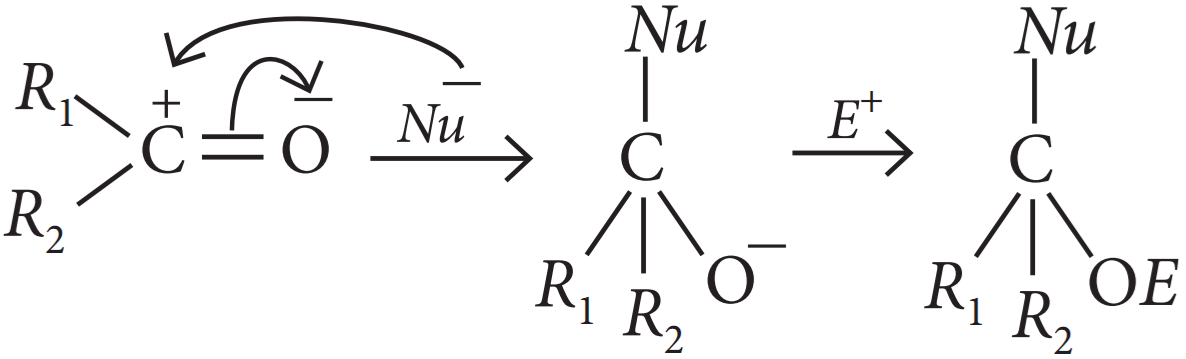 Carbonyl carbon is electron deficient hence acts as an electrophi le. Nucleophile attacks on the electrophili c carbon atom of the carbonyl group from a direction perpendicular to the plane of the molecule.
 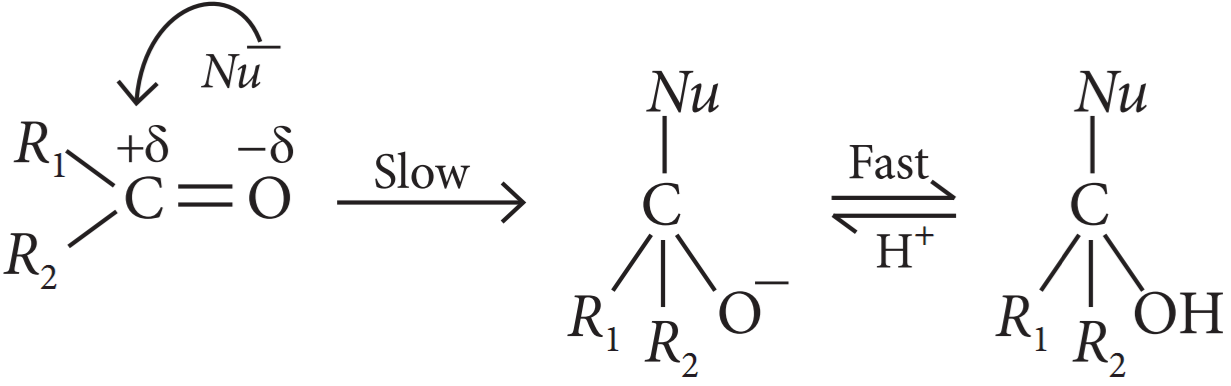 ln this process, hybridisation of carbon atom changes from sp2 to sp3 and a tetrahedral alkoxide ion is formed as intermediate. This intermediate captures proton from the reaction medium to give the neutral product. Aldehydes are generally more reactive than ketones in nucleophilic addition reactions. In these questions (Q. No. l-iv), a statement of assertion followed by a statement ofreason is given. Choose the correct answer out of the following choices.
  (I). CH3CHO(II) and CH3COCH3(III) is I > II > III.
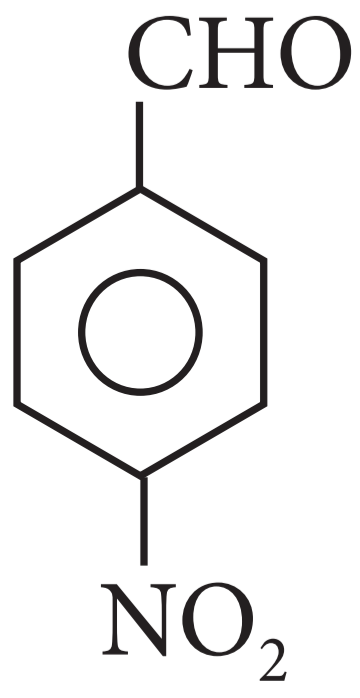 is more reactive towards nucleophilic addition reaction than
 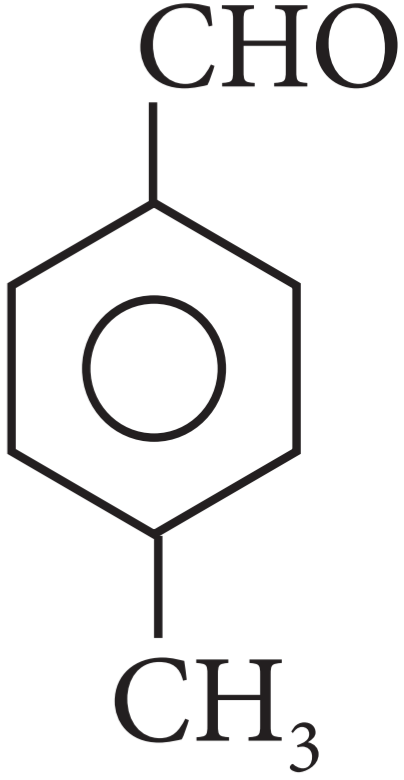 .
.
